
The model
The 11 Differentiation Levers
When a buyer can't tell you apart from the other three agencies on their list, they decide on price. Not because they're cheap, but because you haven't given them anything else to decide with. These eleven levers are every place a real difference can come from.
Start here
Being "the only" is dead
Ten years ago you could say you're the only company doing this for roofers, and it held. Not anymore. The market spots whatever works and copies it by tomorrow, and the moment it does, that's not your advantage.
So stop hunting for the only. Find three to five levers where you're already near the top of the pack, and stack them. One lever is a target. Five is a business a competitor would have to rebuild to match.
One caveat: your actions have to match your claims. Say you prioritize speed, then ship a week late, and you've spent the credibility. That's why this is eleven levers and not a messaging exercise.

You can no longer just go into the market and say we're the only company for roofers, because the market is very good at exploiting whatever efficiencies they find. If they see something's working for you, someone is going to copy you tomorrow, and that no longer becomes your competitive advantage.

The model at a glance: three buckets, eleven levers
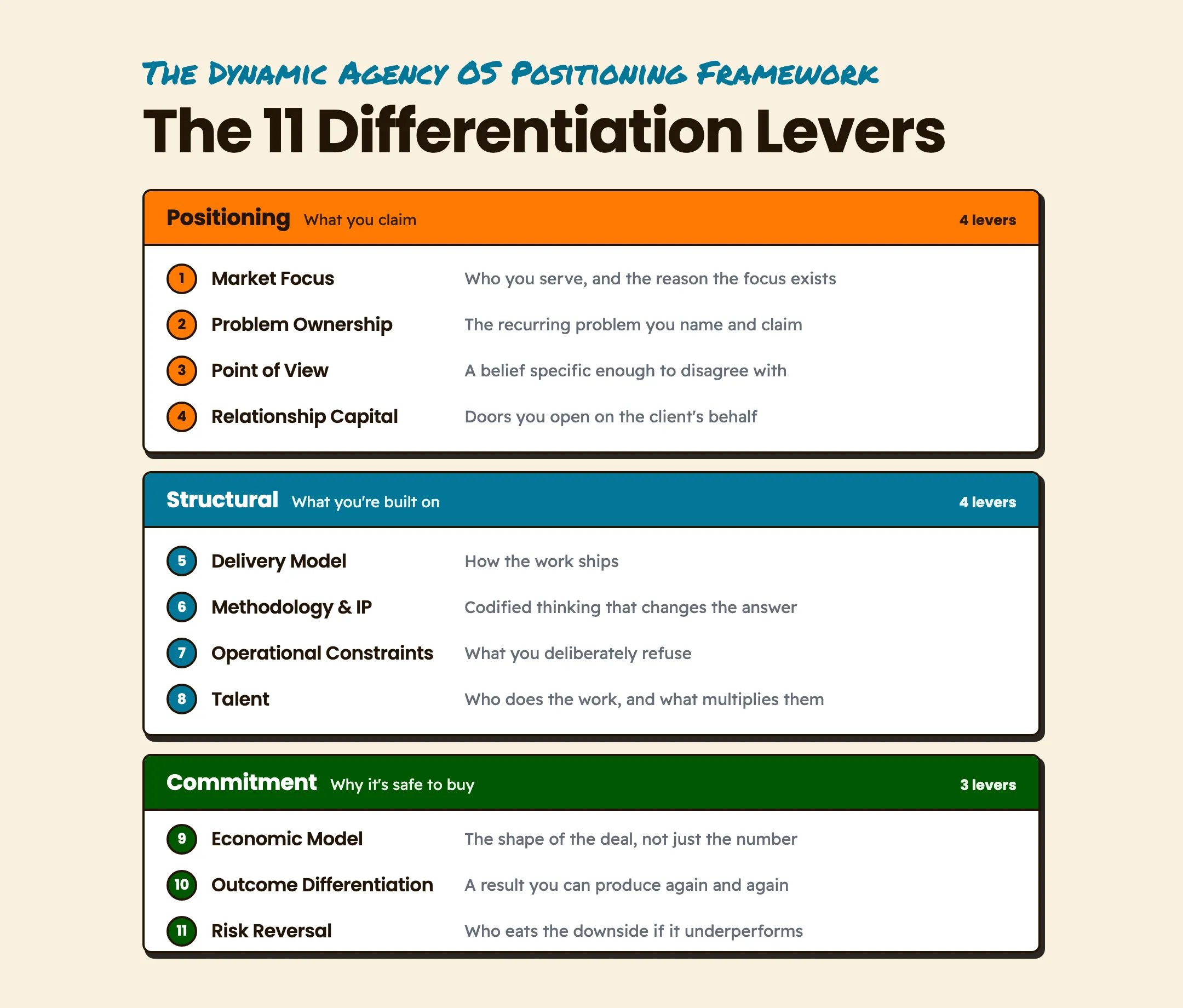
The 11 Differentiation Levers, grouped into three buckets.
Positioning levers, What you claim. 4 levers.
- Lever 1, Market Focus. The industry you serve crossed with the job function you serve. Pick a vertical, find the sub-vertical inside it, then pick the seat at the table you talk to.
- Lever 2, Problem Ownership. The specific problem you name and claim. Not the services you sell, the problem you're known for solving.
- Lever 3, Point of View. The conventional wisdom in your category that you reject, and the conviction to keep saying so.
- Lever 4, Relationship Capital. The access you already have that a buyer would hire you to borrow.
Structural levers, What you're built on. 4 levers.
- Lever 5, Delivery Model. How the work reaches the client. Group or one to one, synchronous or async, the cadence, the room it happens in.
- Lever 6, Methodology and IP. How you think about the problem, plus anything proprietary you've accumulated. Frameworks, sequences, and data nobody else holds.
- Lever 7, Operational Constraints. What you refuse to do. What you say no to says more than the list of what you offer.
- Lever 8, Talent. Who does the work, and why that specific person being on it is rare.
Commitment levers, Why it's safe to buy. 3 levers.
- Lever 9, Economic Model. How you're incentivized to make money, and what that incentive makes you do on a Tuesday.
- Lever 10, Outcome Differentiation. The size of the promise, and your ability to prove you've delivered it before.
- Lever 11, Risk Reversal. How much of the risk you carry instead of the buyer. The explicit guarantee that backs everything above it.

What you claim
Positioning levers
The easiest to reach, which is exactly why they're the most crowded. They're also the easiest to copy, because most of it's a claim until you back it with evidence.
Lever 01. Market Focus
The industry you serve crossed with the job function you serve. Pick a vertical, find the sub-vertical inside it, then pick the seat at the table you talk to.
Why does the buyer benefit from your focus, not just you?
A good TAM is a reason for you to pick a niche. It's not a reason for anyone to hire you. Three hold up: experience (you've worked in this industry), understanding (you solve this same problem somewhere else and bring the outside idea in), or resolve (you care about these people for a reason you can name).
Proof: Client rosters and logos.
Lever 02. Problem Ownership
The specific problem you name and claim. Not the services you sell, the problem you're known for solving.
Is it painful, recurring, impactful, solvable and marketable enough that someone would pay real money to make it stop?
This is the Rumpelstiltskin effect. Name the problem and you have power over it, and when you name it publicly people assume you own the solution. It also changes what your website does. A list of services invites a buyer to find a competitor with the same list and compare on price. A named problem doesn't.
Proof: Case studies about the problem, not the deliverable.
Lever 03. Point of View
The conventional wisdom in your category that you reject, and the conviction to keep saying so.
Which piece of accepted wisdom in your space do you disagree with most, and would you still hold it if it cost you a deal?
The shape is: most [X] believe this, we believe this, here's why. Pick what fills that first blank on purpose. If you're the underdog against bigger firms, name the competition. If your space isn't crowded, name your buyer's status quo instead, because you never want to introduce a buyer to competitors they hadn't thought of.
Proof: A body of content that says the same thing for years.
Lever 04. Relationship Capital
The access you already have that a buyer would hire you to borrow.
Who can you reach on their behalf tomorrow that they couldn't reach in a year?
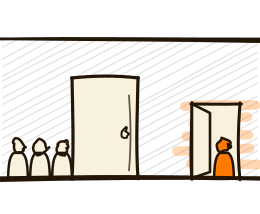
An agent in a captive market got there by doing security work for a pro team, and now places clients inside that organization at a rate nobody else can match. Same recruiting pool as every competitor, same promise, completely different access.
Proof: Named introductions that happened, not a network you describe.
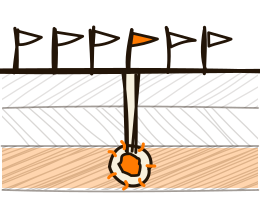


If you come to my site and it says I'll help you with your positioning, I'll help you with your marketing, I'll do SEO, whatever, someone is just going to find a competitor and compare us on price. Versus: I will help you solve this problem if you have it. That's all you need to know.

What you're built on
Structural levers
Much harder to copy, because matching one means a competitor has to restructure their business rather than rewrite a headline.
Lever 05. Delivery Model
How the work reaches the client. Group or one to one, synchronous or async, the cadence, the room it happens in.
If a buyer only knew how you work and nothing else, would that alone be a reason to choose you?
Every other week live, async in Slack in between, so the client keeps their week back. Somebody else runs a 30 minute weekly. Somebody else is voice memo only, reply whenever you send. None is better. The one that matches how your buyer wants to be helped wins, and committing to it publicly is what makes it a lever.
Proof: A model you've held long enough to turn away fits it doesn't serve.
Lever 06. Methodology and IP
How you think about the problem, plus anything proprietary you've accumulated. Frameworks, sequences, and data nobody else holds.
Could a competent competitor reproduce your sequence, or would they have to run your last hundred engagements first?
Not the same thing as delivery model, and the two get conflated constantly. Methodology is why you start an engagement with this before that. IP is the pattern library underneath it, the thing that lets you say we've run this play across this many businesses in your space and here's what it does.
Proof: A named framework you can teach on a whiteboard.
Lever 07. Operational Constraints
What you refuse to do. What you say no to says more than the list of what you offer.
What would you turn down this week, on the record, even if they had budget?
We only do SEO, and we won't touch your social or your website. Or: we take ten clients at a time, and past ten we get diluted, so if you want one of the ten there's a waitlist. Both are constraints a competitor would have to rebuild around, and both tell a buyer what their attention is worth.
Proof: A public no, and a waitlist that's real.
Lever 08. Talent
Who does the work, and why that specific person being on it is rare.
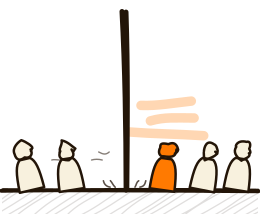
Does your talent claim survive the reply “so you think everyone else hired badly?”
Claiming great talent assumes your competitors have bad talent. They're hiring from the same pool, so they don't. The version that works is specific: the person who built one of the biggest newsletters in the world is on your newsletter. It also works as a constraint, and agencies are notorious here. Selling with senior people and staffing with juniors the week after signature is what a buyer's scared of, so promising the opposite in writing is a lever.
Proof: Names and track records, on the page.



If you're going to claim that we have great talent on your site and you think that's helping you stand out, that's because you're assuming everyone else you're competing with has bad talent. We know that's not true. They're hiring from the same pool.

Why it's safe to buy
Commitment levers
These are what make the other eight believable. They're also where most agencies leave the most ground unclaimed.
Lever 09. Economic Model
How you're incentivized to make money, and what that incentive makes you do on a Tuesday.
Does your pricing pay you more when the client wins, or just when time passes?
Starting out I charged $500 a month, and for every $10K of revenue I helped bring in, my fee went up another $500. That structure got my hands dirty instead of leaving me to hand over advice. One client went from $2K a month to $83K in nine months. Price level counts too. Serving sub-million agencies means building a business that works at a price they can pay.
Proof: The structure itself, published.
Lever 10. Outcome Differentiation
The size of the promise, and your ability to prove you've delivered it before.
Can you name the outcome bigger than your competitors do and produce three clients it happened to?
It ties straight back to the problem you own. If you know the problem, you know the outcome. The nuance is that the outcome a buyer asks for and the outcome they need are often different, so part of the job is showing them the second one without dismissing the first.
Proof: Case studies with the number in them.
Lever 11. Risk Reversal
How much of the risk you carry instead of the buyer. The explicit guarantee that backs everything above it.
Is your guarantee attached to something you control?
Avoid the money back guarantee. It selects for the people who want their money back. My first version was: if you haven't closed $10K of new business 90 days after we finish, I keep working for free. It never got called, but it depended on the client doing their part. The version I run now promises what's in my hands, a complete marketing operating system delivered and running by the end of the engagement, so I'm not guaranteeing work somebody else has to do.
Proof: The guarantee in writing, with its conditions stated plainly.




I would never do a money back guarantee, because you'll generally attract the people who only want their money back.

The long version
All eleven, in 48 minutes
I walked through the whole model with Dustin Riechmann on the 7-Figure Leap podcast. Every lever, with examples, plus how each of us stacks our own at the end.
Jump to a lever
- 00:00Why positioning is everything
- 04:12Stop trying to be "the only"
- 08:21Market focus
- 12:47Problem ownership and the Rumpelstiltskin effect
- 18:33Point of view and relationship capital
- 21:24Delivery model, methodology and IP
- 24:41Operational constraints and the truth about talent
- 31:39Economic model, outcome differentiation, risk reversal
- 38:12All 11, recapped
- 43:08How I stack my own

Worked example
How I stack my own
Five of the eleven, and the reasons behind each. If I couldn't do this exercise on my own business, you'd be right to ignore the rest of the page.
- Market Focus
- Sub-million agencies, because I grew one from there to the three million range. That's experience, not a TAM calculation.
- Methodology and IP
- Dynamic Agency OS is the methodology. The company is named after it. It's a positioning operating system, not a coaching cadence.
- Problem Ownership
- Delivery drag. I used to say referral reliance, then enough other coaches started using the phrase that you could no longer trace it back to me. Delivery drag is the real problem underneath it: you get busy delivering, marketing stops, and referrals are the only leads left.
- Talent
- The talent pool is me. I've run the agency and done the work, and I'm in every session.
- Risk Reversal
- When we're done you'll have a complete marketing system tied to your positioning, every asset you need, and the ability to run it yourself.

I was talking referral reliance, and a lot of other coaches started using that language, so you couldn't look up referral reliance and point it back to me. Then I realized delivery drag is the real problem. Most agencies I talk to get so stuck in delivery that they're not doing marketing, so the only leads they can get are from referrals.
Positioning Snapshot
You don't get to pick which levers the market reads you for
You've just seen the eleven. The harder question is which ones your buyers can currently find, because that's decided by your public footprint rather than by your intentions. The Snapshot is a 30-minute read on exactly that. No cost.
What you walk away knowing
- Which of your levers is already doing the selling, and which strong ones are buried where no buyer ever sees them.
- How a buyer decodes your agency in the first ten seconds, next to what you meant to say.
- The one word or category you're closest to owning, and the buyer you're closest to being the obvious pick for.
I read every application myself and prep before we talk, so the call is spent on findings instead of intake questions. You keep the written read either way.
- Apply. A short form, so I can see your agency before we talk.
- I prep. I run your public positioning through this same lever exercise before the call.
- We talk, 30 minutes. I walk you through what I found, and we land on the fastest move.
- You keep the read. A short written Snapshot, yours whether or not we ever work together.