
Most agencies that say they need more leads can’t reach the people they want to work with. List 10 companies you’d love to win and, next to each, how you’d reach the person who decides. Where the lines are blank, fix access before you rewrite another page.
Lead generation for digital marketing agencies starts with one niche. Pick it, build an offer around the specific problem that niche will pay to solve, and prove you can solve it. Then run a small number of channels well: personalized outreach, founder-led content, and referral partnerships. Done in that order, it can book qualified meetings in 14 to 30 days. Most agencies don’t have a lead problem. They have a focus problem, and no amount of volume fixes that.
Every agency owner who says they need more leads usually needs fewer, better ones. You can buy a list, blast a thousand cold emails, and fill your calendar with people who were never going to hire you, but that isn’t a pipeline you can trust.
It starts with being clear enough about who you attract that the right people recognize themselves in your words and the wrong ones keep scrolling. Get that part right and every tactic below works harder. Get it wrong and you’re just spending money to be ignored faster.
If your agency is earning less than $5M a year, chances are you’re trapped between two equally annoying states: one week you’re in a ghost town, the next you’re doing discovery calls with people who disappear faster than your free trial subscribers. You’re left overthinking everything: your offer, your pitch, your life choices.
Some gurus will tell you it’s all about volume. Cold email the planet. Dial for dollars.
Others will whisper sweet nothings like “just perfect your inbound funnel,” then leave you waiting for leads like you’re in a rom-com. One path gets fast results, one builds trust, neither pays rent consistently.
But what if you didn’t have to pick between quantity or quality? What if you could generate leads quickly and build long-term trust without losing your sanity or budget?
This guide breaks down systems that do just that, specifically built for hungry, scrappy agencies. Let’s talk about getting actual leads, not just more questionably relevant LinkedIn connections.
What is digital marketing agency lead generation?
Digital marketing agency lead generation is the system you use to create qualified, sales-ready conversations on demand. The best versions solve one specific problem for one type of buyer through one clear path to a booked call.
Traditional lead generation casts a wide net and hopes something sticks. Offer-first lead generation starts with a packaged solution to an urgent problem, then builds all outreach around that outcome. Buyers get clarity and you get a pipeline you can predict.
It works because decision makers buy outcomes, not services. When you lead with a clear promise tied to their most pressing issue, the conversation moves from “do we need this?” to “can you really deliver this?”
Digital marketing agency lead generation that survives the first call
Whether your calendar’s emptier than a coworking space on Sunday or it’s packed with tire kickers, the root cause is the same: no consistent, tested way to bring in qualified leads. The goal is the right leads, on repeat.
Below is a breakdown of lead gen tactics that bring together quick-action hustle and long-play systems into a process you can actually use without hating your job.
1. Get Ruthlessly Clear on Your Ideal Client and Offer
No funnel, hack, or LinkedIn trick will save you if you’re pitching to the wrong people or offering them something that doesn’t get their attention (or wallet). This is where most agencies hemorrhage time and money.
Use four basic filters: budget, problem, industry, and urgency. If they’re broke, clueless, irrelevant, or “circle back in Q4”—they’re not your person.
Next, simplify your offer. Don’t just say “we do social media.” Say “we help solo law firms get 10 new qualified leads a month in 90 days using content that doesn’t suck.” Specificity sells. Vagueness kills.
Example: Skip “SEO” and go with “launch-ready SEO for Series A SaaS founders with less than $10K MRR.” It’s oddly specific because that’s what works.
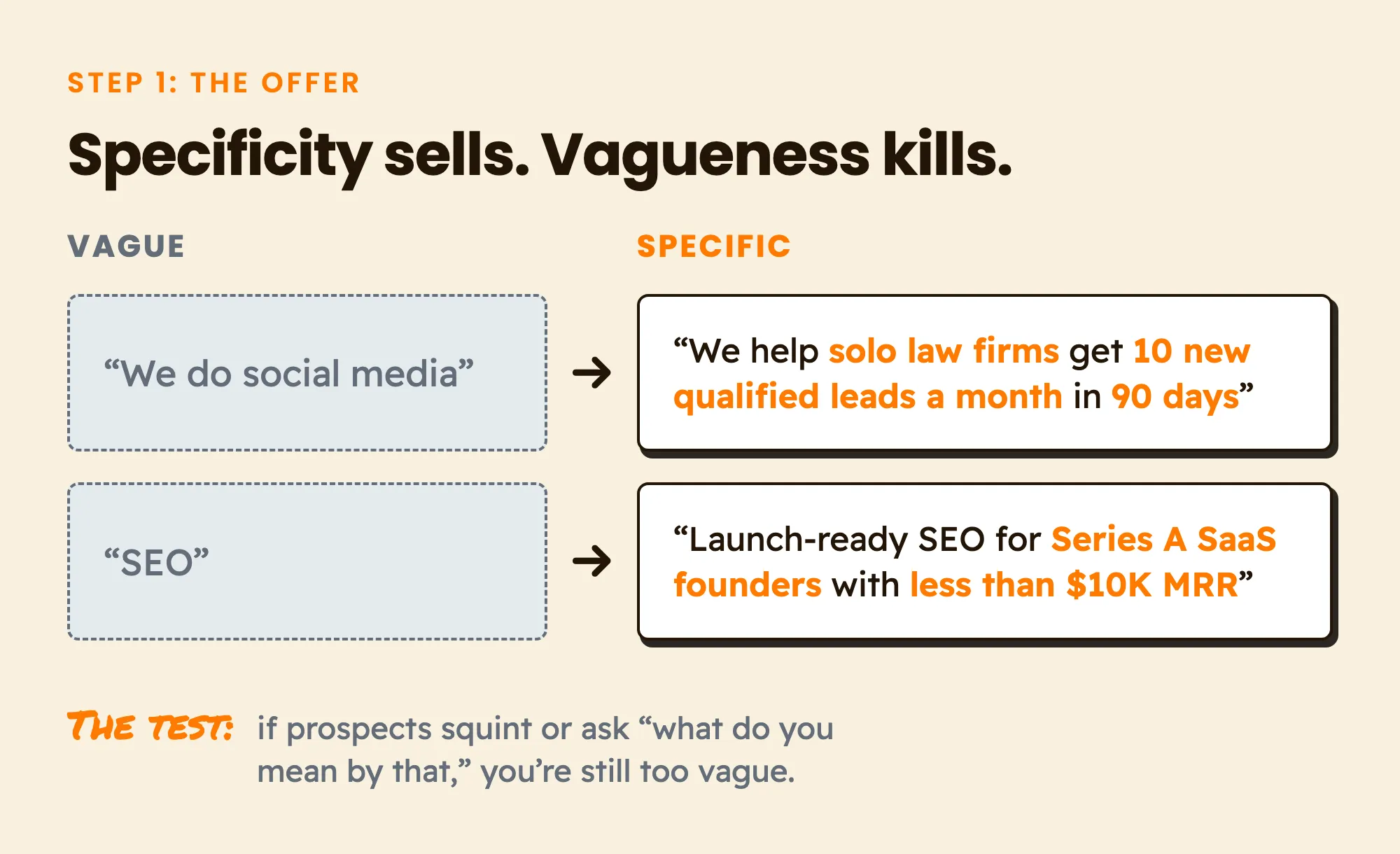
Test your positioning with three discovery calls. If prospects squint or ask “what do you mean by that,” you’re still too vague. Keep sharpening until they nod immediately.
This step is the foundation. Skipping it is like putting gas in a leaking tank—it goes nowhere fast.
2. Package One Urgent Problem as a Snap Offer
Once you know who you’re for, name one outcome you can deliver fast and scope it so a small team can fulfill it without heroics. That package is your lead magnet, your positioning anchor and your way into premium pricing.
Pick the buyer, one painful problem, a clear metric and a timeline of 10 to 30 days. Give it a name a buyer can repeat: “Conversion Tune-Up in 21 Days,” “CAC Rescue Sprint in 14 Days,” “Topic Blueprint in 10 Business Days.” Write the acceptance criteria so the buyer knows exactly what they get and how you’ll measure it.
Price it as a fixed fee, or a starter fee with a credit toward a longer retainer. That answers the usual objection, “we need to see how you work first,” because you’re handing them a bounded way to find out.
Template: For [buyer] with [urgent problem], we deliver [measurable outcome] in [X days], including [3 to 5 deliverables], for [fixed fee]. If we can’t hit the outcome, you get [a prioritized fix list or a credit].
Example: for ecommerce brands with rising CAC, the “CAC Rescue Sprint in 14 Days” includes an audit, a creative reset plan, a targeting cleanup and a six-week test roadmap with projected impact. The fee is $4,500, with $2,000 credited toward implementation.
Then give the offer one page. A single-purpose page turns attention into booked meetings: a headline that states the outcome, a short proof section, five bullets of scope, the timeline, and one call to action such as “Book a Teardown.” Embed your calendar on the page, add a short FAQ and your acceptance criteria, and drop the navigation, the second offer and the generic “contact us” button.
A visitor should be able to answer three questions in ten seconds: what do I get, how long does it take, what does it cost. Everything else on the page is proof or risk reduction. You can build it in two hours, and a one-page PDF is worth linking for the people who forward things internally before they book.
One page and one call to action beat a brochure site. Brochures are for coffee tables, not pipelines.
3. Lead With a Personalized Audit, Not a Pitch
The fastest way to turn a cold prospect into a warm conversation is to do a little work for free, in the open, before you ask for anything. Record a five-minute video walking through their website, their ad account, or their SEO, and name two or three specific things you would fix. You’re not writing a report and you’re not doing the whole job for free. You’re showing them what it’s like to think alongside you for five minutes.
Most agencies pitch. You diagnose. That gap is the entire reason someone books the call. Keep the video short, keep the fixes specific, and end with one obvious next step. A personalized audit beats a polished lead magnet almost every time, because a checklist proves you can format a PDF and an audit proves you understand their business.
Note: Check out the Snap Offer System if you want help here.
What to do in your first 30 days
Week one is a focus decision, and it costs nothing. Write down the one kind of company you want more of and the one problem you solve for it. If you can’t do that in two sentences, stop here, because every tactic after this point will spread across the wrong people.
Week two is an offer. Turn the problem into something with a name, a scope, a price range and a result a buyer can picture. A buyer who sees “monthly retainer” has nothing to say yes to. A buyer who sees a defined project with an outcome does.
Week three is fifty names. Build a list of fifty companies that match your description, and find the person who owns the problem at each. Fifty names you chose have a reason to answer. Five thousand you bought have none.
Week four is outreach and one referral ask. Send each of the fifty a message that shows you looked at their situation, and ask your three best past clients who else they know with the same problem. Do both in the same week so you can compare what comes back.
Then measure. After thirty days you will know which route gave you conversations with the right buyer. Put the next month’s effort there and stop the other.
This is slower than blasting a list. It also holds up better after the first month, because every step depends on the focus decision made in week one.
4. Reactivate Your Warm List First
Your existing contacts already know the quality of your work, which cuts the trust-building time roughly in half. That makes reactivation the fastest route to qualified conversations, and it needs no ads and no new headcount.
Export past clients, partners, newsletter subscribers and stalled opportunities from your CRM and inbox. Pick 50 to 150 names that fit your buyer profile and show a recent trigger: a team change, new funding, a drop in performance. Send 20 to 30 targeted messages a day for one week, by email and LinkedIn, and personalize each with the trigger or your history together.
A three-line email is enough. Subject: “Quick idea for [company].” Body: “[Name], we built a [Snap Offer] that helps [buyer] fix [problem] in [X days]. Open to a 15-minute teardown to see if it fits? Calendar: [link].” Follow it with a LinkedIn note: “Sent you a short idea on [offer]. Happy to send the one-pager.”
Example: a content shop re-engaged five former prospects with “Topic Blueprint in 10 Business Days.” Three booked teardowns that week, and two of them turned into paid sprints within 14 days, because a bounded offer removes the “big commitment” hesitation.
5. Launch Outreach That Doesn’t Feel Like a Spam Bomb
Cold outreach still works. What doesn’t is sending essays that make your prospects work just to figure out what you want.
Keep emails short—four lines, tops. Mention a specific pain. Offer something useful.
An example: “Saw you just hired a growth lead. If you’re scaling up campaigns, we help agencies lower CAC by 20% in 6 weeks.”
On LinkedIn, lead with content first. Warm them up in comments and DMs. Stop pitching out of nowhere—it’s weird.
The secret sauce? Research before you reach out. Find one specific thing about their business, mention it in your opener, then connect it to your value proposition. This takes 30 seconds but doubles your reply rate.
Bonus: Use $10/day retargeting ads on the folks who clicked your lead magnet. You’ll show up like a charming coincidence (not a stalker).
Outreach fails not because it’s “dead”—but because most of it is lazy and robotic. Be better than your inbox competitors.
Build a Hot 100 and run a three-touch sequence
A tight account list beats generic outbound because focus creates relevance and relevance creates replies. Build a list of 100 companies that fit your buyer profile and show a clear trigger: funding, hiring in marketing, a site change, or a channel pullback. For each one, find two or three buyers and influencers through LinkedIn, the company site and recent press.
Then run three touches over seven to ten days across email, LinkedIn and one short voicemail. Each touch teaches the problem and points to your Snap Offer as the fix. You don’t need heavy tooling for this, and your wallet can sit it out.
6. Nurture Leads Without Becoming “That Guy”
Let’s be honest. Most people won’t buy on the first touchpoint. That’s not rejection. That’s just normal.
Set up a 5–7 email welcome sequence that blends helpful ideas, social proof, and just enough personality to remind people there’s a human behind the pixels. Systems like ConvertKit or ActiveCampaign get the job done without needing an engineering degree.
Example: A solo PPC specialist sent two nurture emails a week—quick tips, client wins, no novel-length rants—and closed four new retainer clients in 30 days without doing anything else. Magical? No. Just consistent.
Your nurture sequence should feel like getting advice from a smart friend, not sales pitches from a robot. Share wins, losses, and lessons learned. People buy from humans they trust.
Add a “PS” to every email with a soft CTA. “PS: Ready to chat about your PPC strategy? Book 15 minutes here.” Don’t be pushy, but don’t pretend you’re not running a business.
You don’t need more traffic. You need more people remembering you exist.
7. Qualify Leads So You’re Not Stuck in “Maybe” Purgatory
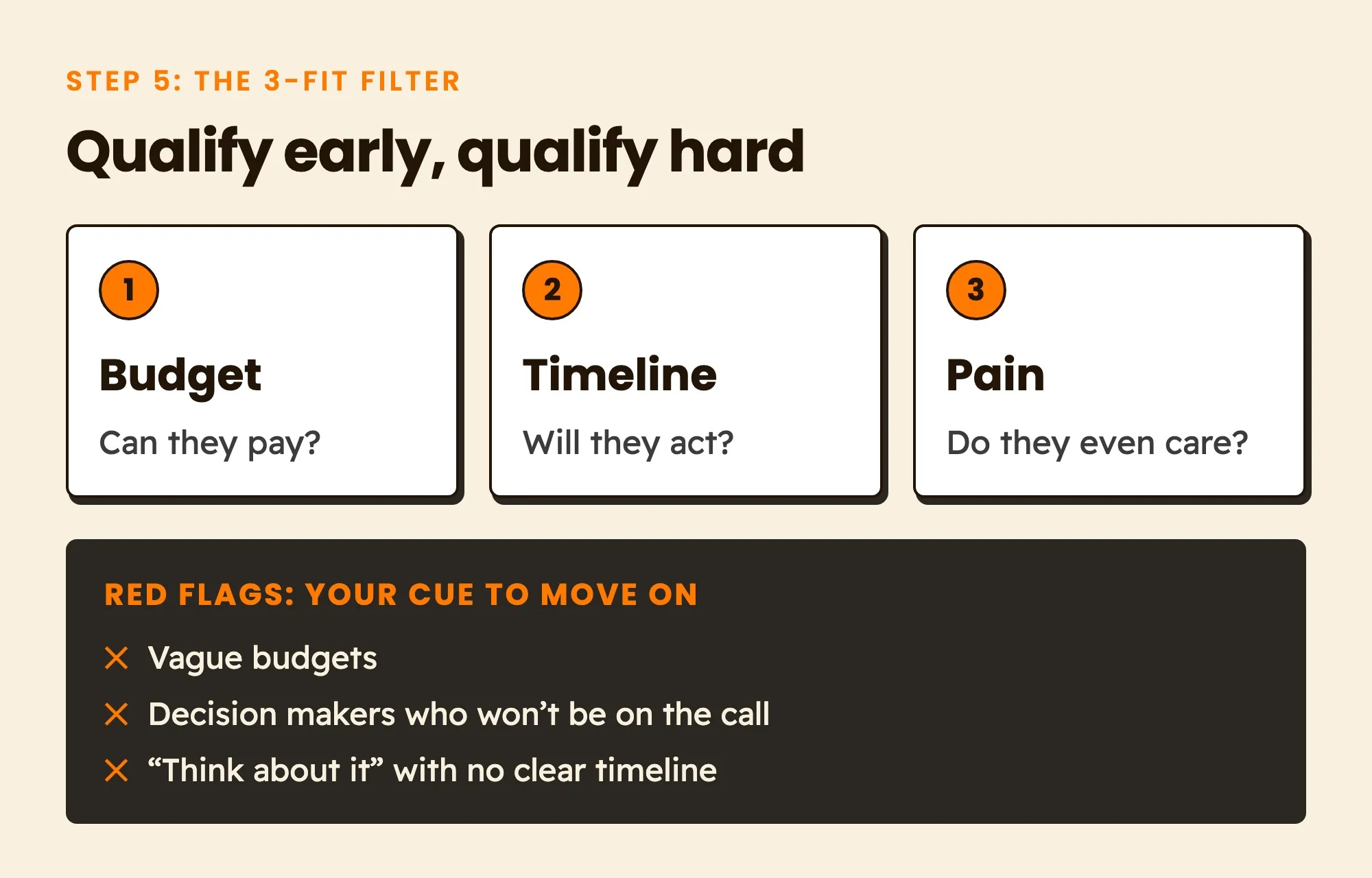
More sales calls won’t save you if they’re with the wrong humans. Qualify early, qualify hard.
Use the 3-fit filter: budget (can they pay), timeline (will they act), and pain (do they even care?). Add 2–3 short questions in your Calendly or intake form.
Then run low-key, structured discovery calls that follow a format—ideally not “tell me about your entire life story.” Three questions cover most of it: What outcome matters most in the next 30 days? What constraint blocks it? If we fix that now, what is the impact? Asking them before you write a proposal improves your close rate, because fit gets settled first.
Red flags to watch for: vague budgets, multiple decision makers who won’t be on the call, and prospects who want to “think about it” without giving you a clear timeline. These are your cues to move on.
Route the warm ones faster. Set an alert for high-intent signals such as repeat visits to your Snap Offer page, views of your pricing, or a reply to your teardown invite, and send those people a priority calendar link with same-day or next-day slots. Everyone else gets your checklist and the next clinic invite.
Stop chasing ghosts. Start filtering like your time matters—because it does.
8. Measure What’s Working (and Admit What’s Not)
If you don’t track what’s actually moving the needle, you’re just guessing—and guessing doesn’t scale. Most agencies track vanity metrics like email opens instead of revenue drivers.
Track: cold email replies, opt-ins from your lead magnet, call booking conversion, cost per lead, close rates. Add meetings by source, meeting rate per sequence, time to first meeting, and pipeline created from Snap Offer calls. Doesn’t have to be fancy. Just has to be visible.
Use Notion, Airtable, whatever makes it easy to spot trends without needing a data science team. A spreadsheet, a calendar tool and a basic visitor-ID tool are plenty. Check your numbers weekly, not monthly—by then it’s too late to course correct.
Set up automated alerts when key metrics drop below your threshold. If your lead magnet conversion rate drops below 15%, you’ll know within 24 hours instead of discovering it during your quarterly review.
Count qualified conversations and the pipeline they create. Your bank does not accept engagement.
Campaigns that suck don’t fix themselves. Kill fast, test faster.
9. Build Strategic Partnerships That Actually Generate Leads
While you’re busy cold emailing, your smartest competitors are building relationships with complementary service providers who refer clients like clockwork. This is the lead gen strategy nobody talks about because it’s not sexy.
Target web developers, business consultants, accountants, and lawyers who serve your ideal clients. These folks often hear “I need help with marketing” but don’t offer those services.
Instead of asking for referrals immediately, start by referring business to them. Lead with value, not your hand out. After you’ve sent them two or three qualified leads, the reciprocity kicks in naturally.
One agency built relationships with five web developers and generated 30% of their revenue through referrals within six months. They stopped chasing leads and started building a referral machine.
10. Leverage Content That Positions You as the Obvious Choice
Content marketing isn’t about going viral or building a personal brand. It’s about demonstrating expertise to prospects who are already in buying mode.
Create content that answers the questions your prospects ask during sales calls. If they always ask about ROI timelines, write about that. If they worry about implementation, break down your process.
Share case studies, behind-the-scenes looks at your work, and honest takes on industry trends. Skip the motivational quotes and generic tips—your prospects can get that anywhere.
Post consistently on LinkedIn, not because the algorithm demands it, but because your prospects spend time there. Two quality posts per week beats daily mediocrity every time.
Teach the problem in public, then host a live teardown
Short educational posts followed by a live session let a buyer see your thinking before they pay for your execution. Over ten days, publish three posts that each name a costly mistake, show a one- or two-step fix, and point to your Snap Offer page. Add one micro-case. Good topics: “3 signals your CAC is bloated and costing you deals,” “How to fix lost conversions above the fold in one afternoon,” “A 10-day content plan tied to revenue hypotheses instead of traffic.” Use the same call to action every time: grab the Snap Offer or book the teardown.
End the sprint with a 30 to 45 minute live teardown. Review examples volunteers send in, show your method, and hand out a simple checklist. Record it, because the replay works as nurture content and social proof. A paid social shop that ran a “CAC Rescue Clinic” booked five qualified calls from attendees and replay watchers. Show your method and the right buyers pick themselves. The wrong ones leave, which helps you.
Show Results, Not Adjectives
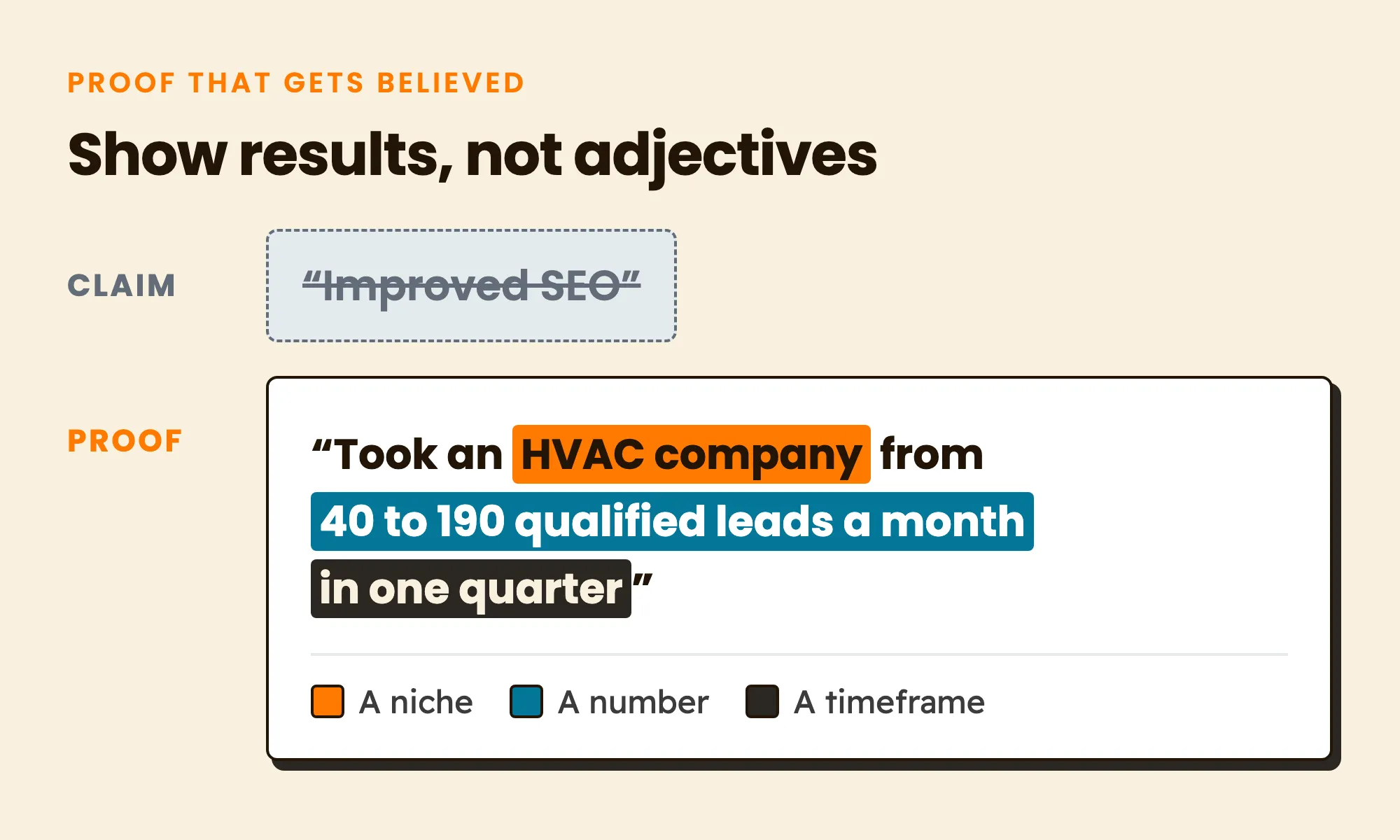
“Improved SEO” means nothing. “Took an HVAC company from 40 to 190 qualified leads a month in one quarter” means everything.
Buyers don’t trust claims, they trust specifics. Every piece of proof you put in front of a prospect should carry a number, a timeframe, and a niche, because that’s what makes it believable instead of promotional.
If you don’t have results yet, borrow credibility a different way: show your process clearly enough that someone can see exactly how the outcome gets made. Clarity about the how buys trust when you can’t yet point to the what.
11. Systemize Delivery So the Offer Scales Beyond You
Once outreach works, delivery has to hold up under more volume. When fulfillment is predictable, you can sell harder without worrying about quality.
Turn your Snap Offer into a checklist with inputs, steps and acceptance criteria. Build templates for audits, roadmaps and recap emails, keep them in a shared folder, and standardize the handoffs. That protects quality when you add freelancers or move from founder-led delivery to a team, and it gives you clean proof for your next micro-case and referral conversation.
Write a one-page delivery SOP: the client access you need, your kickoff questions, a timeline with an owner for each step, and your definition of “done.” Put it in the proposal so buyers see the plan up front. After three “Topic Blueprint” sprints, the content shop above built a slide template and checklists, saved 30 minutes per client and got more consistent across the team.
How to Adapt This for Different Agency Types
The pattern stays the same: an urgent problem, a fast timeline, clear deliverables and a fixed scope. Change the specifics to fit your craft.
- Creative agencies can package a “Brand Clarity Sprint in 14 Days” for startups with messaging confusion, covering brand architecture, a messaging framework and visual direction.
- SEO agencies can offer a “Traffic Recovery Audit in 7 Days” for sites hit by an algorithm update, with technical fixes, a content gap analysis and a recovery roadmap.
- Social agencies can sell an “Engagement Reset in 21 Days” to brands with declining organic reach, with a content audit, a posting strategy and community guidelines.
Why Agency Lead Gen Breaks, and the Fix for Each
If you’re running the steps above and still hearing nothing, the cause is usually one of six things. Check them in this order.
1. Fuzzy targeting
If you don’t know exactly who your offer is for, nobody else will either. “Small business owners, generally” isn’t a profile. Think monthly revenue, headcount, tools, buying behavior and the specific problem keeping them up. Then review it quarterly against your highest-value, lowest-friction accounts. Your best clients from two years ago may not be your best clients now, so ask what they share beyond industry and what event triggered the need.
2. Channel mismatch
Being everywhere usually means being nowhere. Run one audit: list where your last ten clients first encountered you, not where they signed up. Double down on the two or three channels that show up, and drop the rest.
3. A soft offer
“Want to hop on a call?” asks for a lot before you’ve given anything. Lead with a micro-offer instead: a fast audit, a teardown or a short strategy note, specific enough that the right buyer thinks you built it for them. Generic lead magnets die in download folders. Specific ones get forwarded.
4. No system, so no signal
Track one number weekly: new qualified leads. Then ask three questions every seven days. How many new leads came in, what share replied, and how many booked? Also track the story behind the numbers. When someone books, ask which line in your outreach caught their attention. When someone goes quiet after showing interest, ask what changed.
5. Chaotic follow-up
“Just checking in” five days apart isn’t a cadence. Plan five touches over ten days, and make each one stand alone: the problem and micro-offer, a relevant case study, a useful resource, the common objections, then a final ask with proof. Someone who only reads your third email should still think you get it. Give any new approach about 100 touches before changing it. Most agencies quit after 20 and conclude nothing works.
6. Single-threaded outreach
Cold email alone is one flagged domain away from an empty pipeline. Pair it with LinkedIn and a few comments on their posts. When a prospect sees you in more than one place, it reads as social proof even when it’s only good sequencing.
Bad lead gen costs more than calls. Confidence drops, and agencies start saying yes to poor-fit clients just to cover payroll. Fixing targeting and follow-up is cheaper than most of the tools and courses people buy to avoid doing it.
How do I generate agency leads for free?
Start with the channels that cost time instead of money: a personalized audit video, a founder LinkedIn account posting real opinions, and a referral ask to every happy client. None of that needs a budget. It needs consistency.
Can AI or ChatGPT generate leads for my agency?
AI speeds up research, drafting, and list-building. It can’t manufacture trust. Use it to get more personalized outreach out the door, not to automate the personalization out of it. The moment your outreach reads like a bot wrote it, you’ve lost the lead.
Should I buy leads for my digital marketing agency?
Almost never. Bought lists are cold, shared across ten other buyers, and rarely match your niche. You’ll spend more time scrubbing and apologizing than you would building a small, targeted list yourself. Own your pipeline.
How long does it take to generate leads for an agency?
A focused outbound push can book qualified meetings in two to four weeks, and the warm-list and Snap Offer route above is built for 14 to 30 days. Inbound and referral systems take longer to compound but cost less over time. Run both and judge them on different clocks.
What’s the biggest lead generation mistake agencies make?
Trying to reach everyone. An agency that says exactly who it helps and what it fixes will out-generate a “full-service” agency every time. If you’re chasing volume before focus, you’re probably fixing the wrong problem. A close second is measuring activity, such as emails sent and posts published, instead of the meetings and pipeline they create.
One Last Reminder Before You Dive In Like It’s Q4
Revenue doesn’t magically show up because you tried a “clever” tactic. What works is committing to real execution—no shortcuts, no passive-aggressive excuses.
Pick one or two tactics from this list and execute them properly instead of half-heartedly trying everything. A well-executed cold email campaign beats a poorly executed omnichannel strategy every time.
✅ Pick a clear ICP + offer that lands
✅ Package it as a Snap Offer with one page and one call to action
✅ Reactivate your warm list and run outreach that gets replies, not eye-rolls
✅ Set up follow-up that keeps you top of mind
✅ Pre-qualify faster and pitch with clarity
✅ Track like you actually want to grow
It’s Time to Attract the Right People—Not Just More People
The difference between agencies that grow and agencies that spin wheels endlessly? Systems. Not talent. Not “luck.” Just systems that get the work done consistently.
So here’s your game plan: lock in your ICP, package your Snap Offer, run one campaign, and actually track replies. Rinse and adjust.
Most agencies fail because they try to boil the ocean instead of focusing on one proven channel until it works. Pick your weapon, master it, then add the next one.
Want templates, reviews and peers who run this playbook every week? The Dynamic Agency Community is packed with other founders doing the same thing. Join us and build a lead gen engine that doesn’t suck.
Where to go next
If leads arrive but never turn into anything, the problem is further down than the top of the funnel. Why your leads don’t convert covers what breaks between interest and a booked call.
If you’re sending outbound and hearing nothing, why nobody opens your emails is the diagnostic, and an automated follow-up system that stops lost leads is how you stop losing the ones who were interested but busy.
If referrals are still carrying you and you know that’s fragile, start with referral reliance and how to move beyond it, which covers the gap math, the proof strangers need and channels you control. Then use the builder ecosystem map to pick a replacement channel on evidence rather than a guess.
For the channel question specifically, SEO versus paid ads versus partnerships versus outbound is the tradeoff read, and it’s mostly about what stage you’re at rather than which channel is best. The brand-demand spectrum is the framework under that answer, and how I find the room your buyers are already in is how to test the LinkedIn default before you build a plan on it.
If the pipeline is empty for a reason nobody’s named yet, demand-constrained agencies is worth reading before you fix anything, because most agencies fix the wrong end. The agency that wins the demand game makes the same case from the other side: getting faster at delivery does nothing for a pipeline with no demand in it.
If the pipeline only gets attention when it’s empty, the reactive growth trap is the pattern to break, and your biggest client just left is what it costs when concentration catches up with you.
If you’d rather not put money into ads at all, B2B lead generation tactics without ads covers outbound, authority content, referral partners, events and SEO. And if you want to show up when buyers ask ChatGPT or Perplexity, how to get your agency cited by AI search is my honest answer: nobody knows the exact mechanics, so write about how you operate instead of repeating best practices.
If you think the answer is fighting harder for the buyers already in your market, another stall in the same market is the play almost nobody runs, which is growing the number of buyers instead of your share of them.
If you’re publishing every week and still not getting calls, time on brand swaps cadence for a better measure: the minutes a prospect spends with your material before they reach out.
If marketing keeps losing to client work, why your agency is always too busy to market shows how a pipeline thins one postponed week at a time. Treat your agency like your own best client is the fix: give it an owner, a budget, a scope and a status meeting. And why approved content never gets published covers the stall after sign-off, in the small jobs nobody owns.
If you’re still looking for your very first client, why trust beats tactics explains why the warm path works better than blasting strangers at that stage.
If clients hire you but treat you like a vendor, why clients don’t see you as a strategic partner is about reworking your value proposition so you get business briefs instead of project briefs. And if every proposal you send is built from scratch, productized services that sell themselves shows how to package the work so it’s easier to buy.