

I scored 53 agency websites against the same eleven levers over the past few weeks, and 37 of them didn’t clear the bar on a single one. Seventy percent, with nothing on the page a competitor couldn’t also claim.
Before the rest of the numbers, the definition, because most of the arguing about this word happens because two people mean different things by it.
Agency positioning is the set of choices about who you serve, what problem you own, and what you refuse to do. Those choices have to show up in how you’re built, not only in how you describe yourself. If a competitor can paste your sentence onto their site and it’s still true for them, you wrote copy. You didn’t position anything.
That last part is where most agencies come apart, and I can finally put a number on it.
What agency positioning is, and the three things people confuse it with
Positioning sits underneath your brand, your messaging, and your niche. It’s the decision layer. Everything else is expression.
Your brand is what people feel about you, and your messaging is the words you’re using this quarter. Your niche is one input into positioning, and on its own it’s the weakest one. Positioning is the set of commitments that produce all three, and it costs you something to hold. If it costs you nothing, it isn’t positioning yet. I go deeper on the distinctions in positioning vs. differentiation vs. branding vs. messaging, and on the brand question specifically in agency positioning vs branding.
The test I use on every line of an agency’s site is simple, and you can run it on your own homepage in about four minutes.
The Switchability Test: could your closest competitor say this exact sentence?
“We’re a full-service digital agency focused on driving real results for our clients.” Yes, they could. So could 40,000 other agencies. That sentence scores a 2, and I’m being generous, because a buyer’s eye slides off it without registering anything at all.
“We work exclusively with attorneys, so you don’t need to explain why a criminal defense lead behaves differently from a commercial litigation prospect, or why intake speed matters in personal injury.” A competitor can’t paste that unless they’ve built the practice around it. That one scored an 8.
Same length, same grammar, completely different asset.
The five sentences that fail it, in order of how often I saw them
“Full-service.” The most common failure in the sample, and the one that reads as reassurance to the person writing it. To a buyer it lands as unclear what you’re best at, which is a strange thing to volunteer. Nobody hires a surgeon who also does dentistry.
The service list. Fifteen line items asks the buyer to assemble their own strategy out of your menu, price it themselves, and decide whether you’re good at any of it. Services are the supporting cast. The result is the thing being bought.
“Any business that needs marketing.” This is Market Focus scored from the other direction. The sample average there was 4.36, and every agency that cleared the bar on it had given up somebody to do it.
A custom proposal for every inquiry. This one is a positioning symptom people file as a sales problem. When the offer isn’t decided, every quote is invented from scratch, and you compete on whatever the buyer named. A signature engagement with a fixed shape is the fix, and it shows up in the scores as Economic Model, which averaged 2.85.
Staying wide out of fear. The worry is that a niche closes doors. The data says the opposite by a distance: niched agencies in my sample cleared the bar on nine times more levers than generalists. The doors were mostly not opening anyway.
Four of those five cost nothing to fix this week, because they’re editorial decisions about what your site says. The fourth one, the proposal, costs something real, which is exactly why it’s worth more.
How I scored 53 agencies
I want to be straight about the method, because a number you can’t interrogate isn’t worth much.
Forty-six of these were scored from public footprint alone: homepage, about page, services page, and pricing page if one existed. The other seven were full Positioning Snapshot reports or Advantage Intensives, which go a lot deeper. Every agency got scored on the same eleven levers, on a 1 to 10 scale, and every score above a 3 had to carry a verbatim quote from the site. No quote, no score. That rule is what keeps a scorer from grading vibes.
The sample spans sixteen service categories. Full-service shops, SEO, paid media, web design, branding, B2B demand gen, ecommerce, content, email and lifecycle, social, video, PR, RevOps, small local shops in secondary metros, and two rounds of vertical specialists. Candidates were taken in the order public directories returned them. I didn’t hand-pick agencies whose positioning looked weak, because that would rig the whole thing and I’d deserve to get called on it.
Two limits worth stating. Forty-six of these agencies never got a say, so if the asset exists and the website hides it, I scored the website. And a public-footprint read isn’t a substitute for sitting with an owner for two days. It’s a read of what a buyer sees, which is a different question than what’s true.
One accident turned out useful. Five agencies got scored twice by different people working blind, and the two sets of scores landed within one point of each other 87% of the time, with a mean gap of about half a point on a ten-point scale. So the instrument isn’t just one person’s mood on a Tuesday.
The 70%
Across all 583 individual lever scores, the spread looks like this.
| What the score means | Share |
|---|---|
| 7 or above (clears the bar) | 6% |
| 4 to 6 (about as good as everyone else) | 46% |
| 1 to 3 (a buyer wouldn’t register it) | 48% |
Nearly half of everything I looked at scored in the bottom band. That doesn’t mean those agencies are bad at their work. Plenty of them are clearly excellent at the work. It means that on the specific question of “is there anything here a competitor couldn’t also claim,” the answer was no, over and over.
The per-agency view is the one that got my attention:
| Agencies | |
|---|---|
| Zero levers clearing the bar | 37 of 53 (70%) |
| At least one lever | 16 of 53 |
| Two or more | 9 of 53 |
| Three or more, which is a working stack | 6 of 53 (11%) |
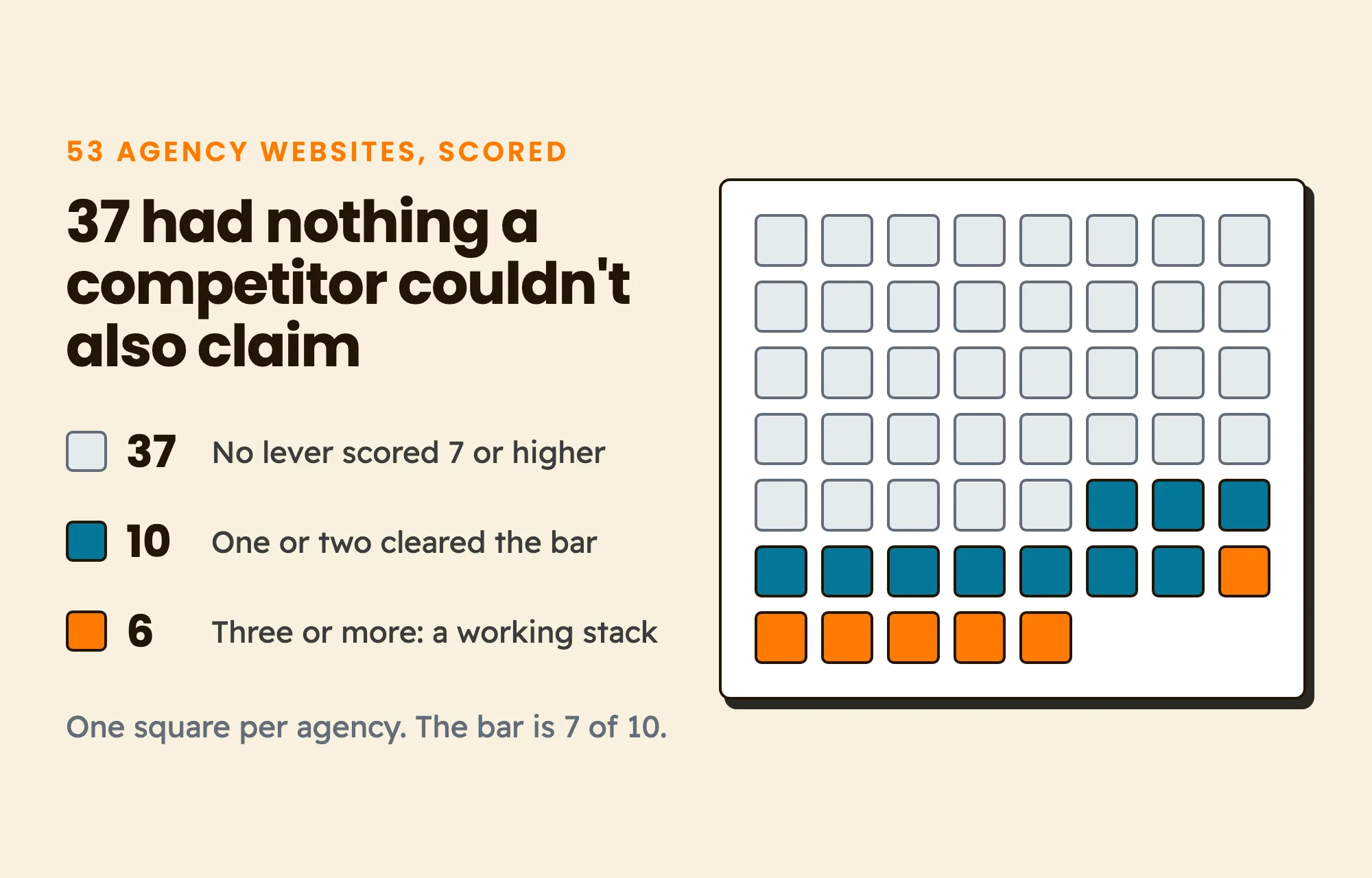
Eleven percent. That’s how many agencies out of 53 had three things going for them that a competitor couldn’t copy by Friday.
If you’re reading that and feeling a little sick, I’d point out that you’re in the 70% with almost everyone else, including agencies doing eight figures. Most of them got there the same way, by drifting into the sea of sameness one accommodating yes at a time. This is the normal state of the market. It’s also why the ones who fix it pull away so fast.
Agency differentiation in 2026: what owners say and what their sites show
Ask agency owners whether they’re differentiated and most of them say yes. RSW/US surveyed North American agencies for its 2026 report on agency positioning, and more than 80% said their agency was “somewhat” or “very” differentiated from its competitors.
That survey asked the owners, and I scored the sites, where 37 of the 53 agencies didn’t clear the bar on a single lever.
Both numbers can be true, and the gap between them is where most of the fixing happens. An owner answering a survey is grading everything they know about their own shop: the client they turned down last spring, the senior people who stay on the account, the result they got for someone they can’t name publicly. A buyer only gets what’s on the page. If the difference lives in your head and on your sales calls, the buyer never meets it, so they compare you on price because price is the one thing left to compare.
So the first move for differentiating an agency in 2026 is checking whether the difference you already believe in shows up anywhere a stranger would find it. Three questions do most of that work:
- Which sentence on your site proves it? If you can’t point to one, it doesn’t count yet. That’s the same no-quote, no-score rule I used on all 53.
- Could a competitor paste that sentence onto their site and have it still be true? If they could, you’ve described your category.
- What does it cost you? Risk reversal, operational constraints and economic model all averaged under 3 across the sample, and each of them asks you to give something up the day you commit.
Most of the owners in that 80% do have something. The trouble is that nobody outside the building can see it, which is the cheaper of the two problems to fix, and the rest of this piece will help you tell which one you have.
The levers you can write score 4.3. The levers you have to build score 2.5.
This is the finding I’d tattoo on something.
Split the eleven levers into two groups. The first group is the stuff you can express in copy: your point of view, the problem you own, the market you serve. You can change all three this afternoon in a text editor.
The second group is the stuff that requires you to change how the business is built: what you refuse to take on, how you charge, who carries the risk if the work underperforms. You can’t write your way into any of those. You have to decide something and then live with it.
| Average score | |
|---|---|
| Levers you can write | 4.32 |
| Levers you have to build | 2.52 |
Same 53 agencies, same scorers, same afternoon.
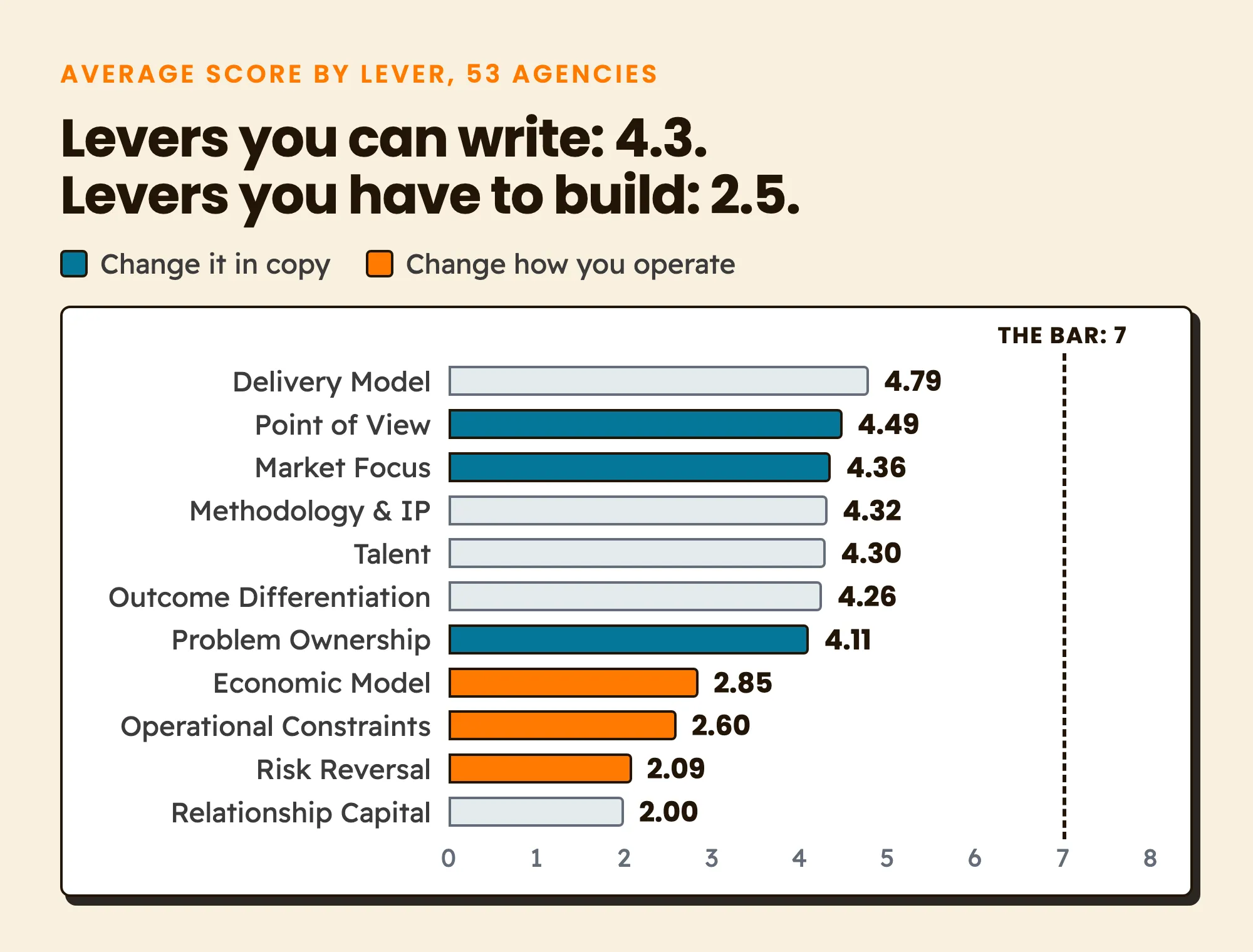
So when people say positioning is a strategy problem and not a messaging problem, that’s the shape of the evidence. Most agencies pick perfectly decent words. The trouble is that words end up being the only layer they ever change, so the layer underneath stays exactly where it was, which is why the new homepage never moves the pipeline.
I’ve done this myself, by the way. I’ve rewritten a homepage, felt great about it, and changed nothing about who I’d say no to. The copy got sharper and the business stayed identical, because I’d edited the description of the thing instead of the thing.
Nobody, in 53 agencies, clears the bar on relationship capital
Relationship Capital is the lever where you activate your own relationships for the client: introductions they couldn’t get, podcast placements in their niche, putting them in front of an audience you built.
Average score across 53 agencies: 2.00. Forty-six of the 53 scored a 3 or below.
Not a single agency in the entire sample cleared the bar on it. Zero. It’s the only lever in the framework with no qualifying example anywhere in the dataset.
That surprised me, because most agency owners are sitting on some version of it. You know people. You’ve been useful to them for years. You could probably get three of your clients on a podcast next month if you sent four emails. But it doesn’t show up anywhere on the site, so a buyer comparing you to two other shops has no idea it exists.
There’s a catch that disqualifies most of what agencies do claim here. A partner badge doesn’t count, and neither does a “we’re well connected” line, and networking that only ever feeds your pipeline is a lead source that belongs on a different page. This lever is about doors you open for the client, and the moment you point it at them, it counts.
Cheapest gate-clearer on the board and the entire industry is walking past it.
The eleven levers, defined
These are the eleven places differentiation can live. Most agencies pull zero or one. You need three that fit together.
Positioning levers
-
Market Focus. Who you serve, and how deep your understanding goes. “We serve healthcare” is a label. Knowing why a 12-provider orthopedic group buys differently than a solo dermatologist, and what the practice manager gets measured on, is focus. Sample average: 4.36.
-
Problem Ownership. A specific recurring problem you’ve named and claimed. Buyers don’t search for solutions, they search for someone who understands the problem, so if you can describe the symptoms better than they can, you’ve won most of the trust before the first call. The sentence-level version of this is the positioning statement template. Sample average: 4.11.
-
Point of View. A belief about what works and why the standard approach fails, specific enough that a reasonable person could disagree with you. “Good marketing matters” is a greeting card, and someone should be able to build a competing agency on the opposite belief. It’s also the lever doing most of the work in your unique selling proposition. Sample average: 4.49.
-
Relationship Capital. Covered above. Sample average: 2.00, and nobody cleared it.
Structural levers
-
Delivery Model. How the work ships. Timelines, who’s involved, team shape, cadence. Everyone runs twelve-month retainers with monthly reporting, so a two-week sprint that shows movement is a structural choice a competitor would have to rebuild their whole operation to match. Sample average: 4.79, the highest of the eleven.
-
Methodology & IP. A named, documented way of thinking that changes the answer. The diagram gets copied by Tuesday. The judgment behind it doesn’t. A framework nobody has seen run is a brochure. Sample average: 4.32.
-
Operational Constraints. What you refuse. Client caps, revenue floors, work you turn down. One agency in my sample publishes a strict non-compete: one client per niche per market. That’s a refusal with a price tag, which is why it scored a 7. Sample average: 2.60.
-
Talent. Who does the work, and whether the person who sold it is the person delivering it. Buyers have been burned on this so many times the bar is underground, which makes it easy to clear if you’re honest. Sample average: 4.30.
Commitment levers
-
Economic Model. The shape of the deal. Hourly and monthly are both fine and neither says anything. One ecommerce shop in the sample charges a percentage of growth above an agreed baseline, and it scored an 8, because the structure itself proves where their incentives sit. Sample average: 2.85.
-
Outcome Differentiation. A repeatable pattern rather than one flattering case study. My favorite example in the whole dataset: an email agency showing three separate named clients whose owned revenue share all landed between 31% and 36%. Three clients converging on one range is a pattern. One client at 400% is variance with good design. Sample average: 4.26.
-
Risk Reversal. Who eats the loss if it doesn’t work. A guarantee, a performance threshold, a paid pilot. Sample average: 2.09, with 44 of 53 agencies at a 3 or below.
Look at the bottom four: Relationship Capital, Risk Reversal, Operational Constraints, Economic Model. Now look at what they have in common. Every one costs you something the moment you commit to it. Money you won’t make, or revenue you turn down on purpose.
The ranking of these eleven levers is almost exactly a ranking of how expensive each one is to mean.
What separates a 5 from a 7
A 5 is not an insult. A 5 means you’re doing that lever about as well as everybody else, which is adequacy. It keeps you in the conversation and it never wins the conversation.
A 7 is the gate, and it’s a high bar on purpose. Three questions have to come back yes:
Have you done it at least five times? Is it protected by a trade-off you’re paying for? Would a competitor need twelve months or more to match it?
Most agencies skip the next question, which is whether the buyer cares. Would they want this, would they understand it without a tutorial, and would they pay because of it? A brilliant lever your buyer is indifferent to is a hobby.
Two calibration rules do most of the work when I’m scoring. Named but not demonstrated caps at a 6. If you’ve got a named methodology and no evidence of it running, a buyer files it as a mention. And anything a competitor could say word for word gets a 6 or worse regardless of how good it sounds.
Why three 7s beat one 10
Clearing the gate on one lever makes you better than most agencies on one dimension. But buyers compare across several dimensions at once, so a competitor who’s strong somewhere else turns the decision into a coin flip, and coin flips get settled on price or chemistry.
Stack three, and the odds a competitor matches all three collapse.
A stack has to work as a chain. Your market focus explains your point of view. Your point of view justifies your pricing. Your pricing proves the constraint is real. A competitor can copy any single link. Copying the chain means becoming a different company, and nobody does that on a Tuesday afternoon.
Six agencies out of 53 had a working chain. The strongest one in the sample was a manufacturing specialist with six levers clearing the gate, and reading their site felt different from reading the other 52. They publish their fee ranges, they’ve written an actual manifesto, and they list who they’re a fit for alongside a line about passing up more work than they take. You finish that homepage knowing exactly whether you’re their client.
Niching is what makes the other ten levers possible
Of the 46 agencies I scored from public footprint, exactly 23 had committed to a named vertical or buyer type and 23 hadn’t. Clean split, which was luck.
| Levers clearing the bar, per agency | |
|---|---|
| Committed to a niche | 1.22 |
| Generalist | 0.13 |
Roughly nine times the differentiation.
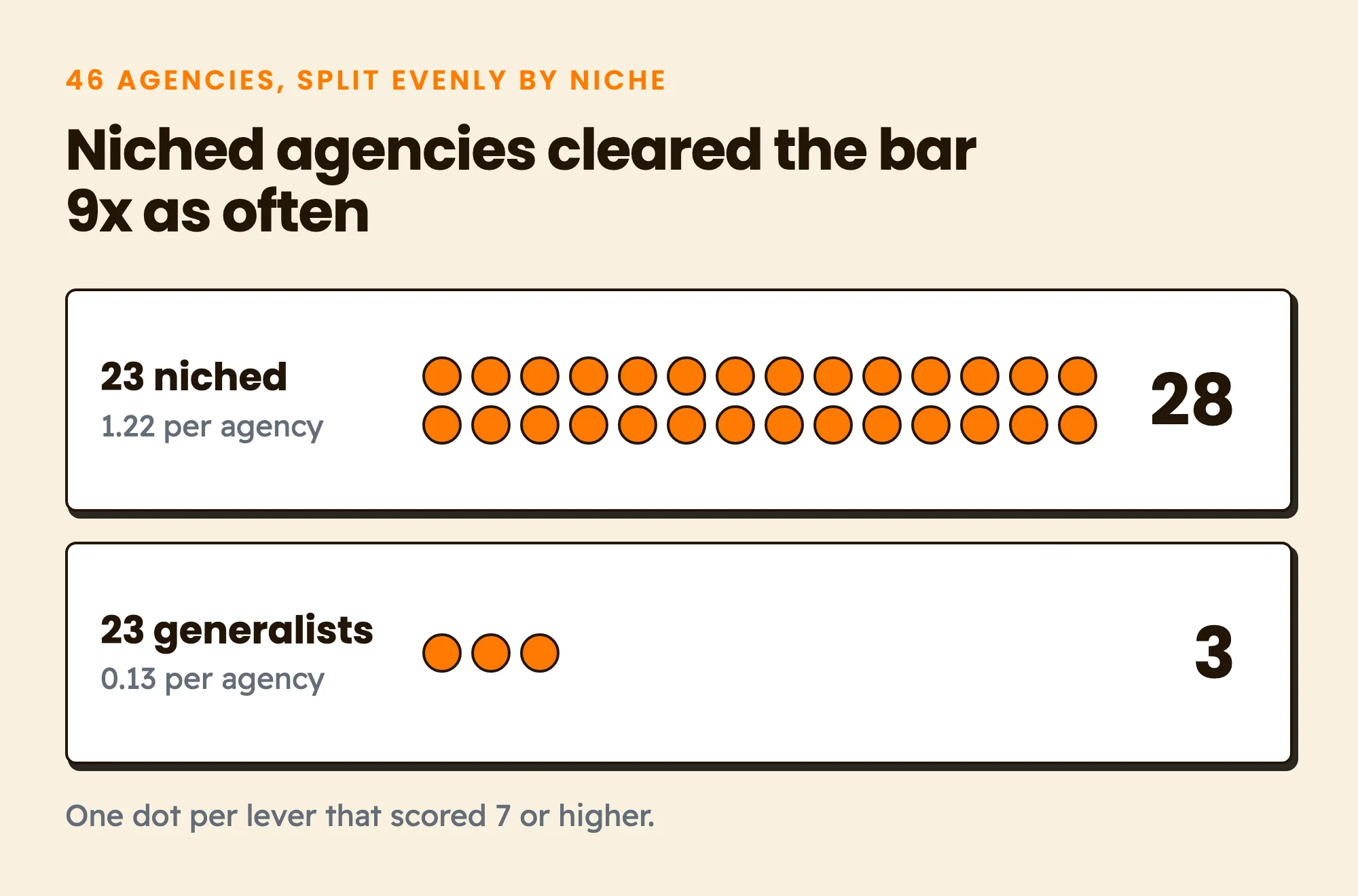
But the mechanism isn’t what most people assume, and two agencies in the sample show it perfectly. Both serve exactly one industry. One is a legal marketing agency that argues practice-area buyer behavior, state bar advertising rules, and cost-per-signed-case in detail, and scored an 8 on Market Focus. The other is a dental agency whose entire public footprint is a four-page brochure with no about page, no named humans, no case studies, and no process. It scored a 5, and almost everything structural underneath it scored a 1 or a 2.
Same commitment to a single vertical. Wildly different result.
Picking a niche doesn’t differentiate you on its own, because 40 other agencies picked your niche this quarter after a conference talk told them to. What the niche does is make the other ten levers knowable. Once you serve one kind of buyer, you can name their problem precisely, hold a sharp opinion about their industry, refuse the work that doesn’t fit, and price against an outcome you can predict. It also changes what your outbound sounds like, which I covered in positioning for lead generation. Try any of that while serving everyone and you’ll write mush, because mush is the honest answer when the question is “who is this for” and the answer is “anyone.”
If you’re still weighing this one, I wrote about the decision itself in should your agency niche down and about doing it without torching your book in niche marketing for agencies without losing clients. And if you’ve already niched and the phone still isn’t ringing, that’s usually urgency and framing, which I took apart in why niched agencies still get no leads.
The most fixable problem I found: you have it and you’re hiding it
Some of these agencies weren’t undifferentiated at all. They’d buried the differentiation somewhere a buyer would never look.
One enterprise UX shop had sharp material sitting right there: an unusual market focus, a stated refusal about work they won’t take standalone, and a specific argument about who touches the account. All of it was inside collapsed FAQ accordions at the bottom of the homepage. The hero said “a global branding and UX design agency.”
An email agency’s homepage carried four impressive statistics that turned out to be industry-wide email benchmarks, not their results. Their own results, eight named clients with dollar figures attached, were one click away on a page most visitors never reach. The nav item labeled “case studies” went to a contact form.
A video shop had a section literally headed “problems we solve” that listed four attributes of the agency and not one problem belonging to a buyer.
If any of that stung a little, good news: this is the version of the problem you can fix this week. What’s missing is an editorial decision about what belongs above the fold. Move it up, put it in the hero, and let the accordion hold the shipping policy instead. I wrote more on that gap between what’s true and what’s visible in how do I know if my positioning is working.
Score your own agency
Do this now, on your own homepage, before you talk yourself out of it. Ten minutes.
Open your site. For each lever, find the sentence on your public pages that proves it. Not the sentence you’d say on a sales call. The one a stranger would find without help. If you need the fuller definition of any lever while you score, the framework page has all eleven with an example each.
| Lever | Your score, 1 to 10 | The quote that proves it |
|---|---|---|
| Market Focus | ||
| Problem Ownership | ||
| Point of View | ||
| Relationship Capital | ||
| Delivery Model | ||
| Methodology & IP | ||
| Operational Constraints | ||
| Talent | ||
| Economic Model | ||
| Outcome Differentiation | ||
| Risk Reversal |
Rules, and they’re the same ones I used: if you can’t find a quote, the score is a 3 or lower. If a competitor could say the sentence, it’s a 6 at best. If you named a thing but can’t show it running, 6 is your ceiling.
Now ignore your lowest scores and circle your highest three, whatever numbers they landed on.
If nothing hit a 7, you’re where 70% of the market is, and you found that out in ten minutes instead of over two years of wondering why your close rate is stuck.
Pick three. Leave the rest alone.
The goal was never eleven good scores. You’re after three to five levers you can own, built hard enough that nobody in your category matches the whole set. So the useful number on your sheet is your top three, and your bottom three are mostly none of your business.
That gets missed constantly and it’s expensive. If a lever came back a 2, and moving it would mean rebuilding how your company works, that’s information and it is not a task. Mark it and go. I’ve watched owners spend a quarter dragging one weak lever from a 2 to a 4 and buy nothing with it, because a 4 is still invisible to a buyer. The same quarter aimed at a 6 they already had would have produced a 7 and a reason to be chosen.
Your stack comes from one of two places.
The first is a lever you’re already close on. A 5 or a 6 usually means the asset exists and your site is hiding it, or it’s visible and reads like everyone else’s. That’s the cheapest 7 available to you, because you’re publishing something already true instead of building something new. Most of the agencies I scored had one of these sitting right there.
The second is a lever nobody in your category has claimed. Look again at where the whole market bottoms out: relationship capital at 2.00, risk reversal at 2.09, constraints at 2.60, pricing at 2.85. Those levers aren’t difficult. They’re unclaimed, because each one costs something the day you commit and almost nobody wants to pay it. Which is why the first agency in a category to publish a genuine refusal or a genuine guarantee takes that ground without a fight.
If nothing on your sheet is above a 4, you’re at a starting line rather than in trouble, and the opening move is small. Pick one specific problem you’re willing to own and give it symptoms, so a buyer reads it and feels caught. Say why that problem exists and why the usual approach fails, specifically enough that someone could disagree with you in public. Then change one structural thing about how you deliver or charge that proves you believe it.
The first two are claims, and the structural change is what converts them into positioning. Skip it and you’ve written a manifesto.
The template I use with clients: “We solve [specific problem] for [specific buyer] by [structural choice], because we believe [point of view].”
One problem, one belief, one structural proof. That beats roughly 70% of the agencies I scored, which I know sounds like a low bar, and it is. Take it anyway. Getting from there to a full stack usually runs six to twelve months, and it starts with the one thing you’re willing to give up. If you’re starting an agency rather than repairing one, position first and pitch second saves you this entire article in about two years.
Write the sentence, then hand it to a stranger
Filling in that template takes about twenty minutes. Getting it to survive contact with somebody outside your industry is the part that takes a few drafts, and it’s the part that tells you whether you decided anything.
Four checks, in the order they usually fail.
The buyer has to be narrower than a category. “SaaS companies” is a label. “Series A SaaS teams losing users in the first week” is a buyer, and the difference is whether someone reads it and recognises their own Tuesday.
The problem has to cost money. Lead with the thing that has a line item attached, not the service that addresses it. A buyer will fund a problem they can already feel and defer one you had to explain to them.
The approach has to be a choice, not an adjective. “Data-driven” is a shrug. “Two-week sprints, flat fee, no retainer” is a decision somebody had to make and can’t unmake quietly. If a competitor could paste your approach into their deck by Friday, it isn’t one.
Cut every word you can’t prove. Innovative, bespoke, holistic, strategic, integrated. Each one is a claim with no evidence attached, and an experienced buyer discounts the whole sentence for carrying them.
Then run the actual test, which takes five minutes and no software. Say the sentence out loud to somebody who doesn’t work in marketing, and ask them what you do and who for. If they can give it back to you roughly intact, you have something a buyer can repeat to a colleague, which is how most agencies actually get chosen. If you get the polite nod, the sentence is still describing you rather than landing on them.
Ask the same person again two days later. The version that survives that is the one worth putting on the homepage.
A useful thirty-day shape for all of this: week one, score the eleven levers and pull your last ten clients apart looking for the pattern nobody wrote down. Week two, pick the buyer and the problem and commit on paper. Week three, rewrite the homepage hero, the LinkedIn headline and the first line of your outreach so all three say the same thing. Week four, put it in front of people and listen for your own words coming back. The first three weeks are the easy ones, and the fourth is the only one that tells you anything.
Where to go next
If you scored yourself and the honest answer to “what makes us different” came back as “we do better work,” how to explain what makes you different when you do the same thing as everyone else shows where the difference usually sits instead, which is everything around the work. The differentiation problem no one talks about covers the next step: saying something a reasonable person could disagree with, and saying out loud who you aren’t for.
If you’re tempted to fix it with one clever angle, the onlyness fallacy explains why a claim nobody else makes is worth less than one you can prove again and again. Legacy bias is the other shortcut that backfires: copying the visible plays of agencies a few tiers up, when what’s paying off for them is a reputation and referral engine you can’t see from outside.
If you’re working on the word rather than the levers, how to find the one word your agency owns is about digging it out of how you already run the place instead of brainstorming adjectives. Once you have it, personal brand or agency brand is the next decision, and the answer depends on what you’re building toward, including whether you ever want to sell.
If AI is where your positioning feels shakiest, which agency differentiators AI just made worthless separates the ones you can only claim from the ones a buyer can check before signing. Why your AI pitch is devaluing your work covers what happens when you sell AI as efficiency and the buyer hears less effort for the same price. And culture as the competitive advantage makes the case that how your team works together is harder to copy than any tool.
And if the positioning is decided and deals still stall at the end, why you keep losing deals to the prospect who does nothing treats the status quo as a competitor that beats most agencies on trust, cost and risk. Why results alone won’t build trust is the other half of that stall: buyers want to see how you’ll get them there, not only what you did for someone else.
If the trouble is getting in front of buyers at all, a no-fluff go-to-market strategy connects the positioning to one or two channels you’ll actually use. And when the offer is clear but the months still swing, why agency revenue feels like a roller coaster goes through the usual causes, from too many one-off projects to offers too vague to sell easily.
Common questions
What are the four types of positioning?
Most textbooks split it into competitive positioning, product positioning, price positioning, and customer positioning. Useful in a classroom. For an agency I’d throw it out, because all four collapse into the same practical question: what have you committed to that your competitor hasn’t? The eleven levers above are that question broken into places you can look.
What’s the difference between positioning and branding?
Positioning is the decision. Branding is the expression of it. You can rebrand every eighteen months and never once position anything, which is a fairly common and expensive way to spend two years.
Do I have to niche down to have positioning?
Technically no, practically almost always yes. The data above is fairly blunt about it: niched agencies cleared the bar on nine times more levers. The niche itself isn’t doing the work. What it does is make the other levers possible to answer at all.
How long does repositioning take?
The decision takes a day. Making it visible everywhere takes a quarter. Getting the market to repeat it back to you takes six to twelve months. Most people quit somewhere in month two, right when the old pipeline has thinned and the new one hasn’t filled. That stretch is miserable and it’s also supposed to happen.
What if my positioning is right and nothing’s changed?
Check whether it’s visible before you check whether it’s correct. A third of the problems I found were assets buried below the fold. Also check whether you’re measuring the right thing, because revenue lags positioning by a long way. The earlier signal is hearing your own language come back at you from someone you’ve never met, which I’ve written about as the language mirror.
Isn’t a 7 out of 10 a low bar for a “strength”?
It’s higher than it sounds. A 7 means a competitor couldn’t honestly paste your claim onto their site. Only 6% of the 583 scores I gave cleared it, and I gave those scores with the quotes sitting in front of me.
Where this leaves you
Positioning isn’t a copywriting problem, and the numbers say so pretty clearly. The levers you can write are the ones agencies score highest on, and the levers that require a decision are where almost everyone bottoms out. If your last repositioning was a homepage rewrite, that’s why nothing moved.
The upside is that the bar is on the floor. Three levers that fit together puts you ahead of 89% of the agencies I looked at. One real refusal puts you ahead of most of them on its own.
If you want your own eleven scores instead of guessing at them, that’s what a Positioning Snapshot is. Same eleven levers, same scoring rules, run against your site, your LinkedIn, your Google results, and what AI assistants say when someone asks about you. You get the scorecard and the one lever worth building first.
And if you’d rather just run the table above yourself this afternoon, do that instead. The agencies that fix this are the ones who looked honestly at their own homepage first, and you already know which sentence on yours you’ve been avoiding.