

Try to find out what an agency coach charges and you’ll mostly find a booking link. It’s a category that sells clarity and prices itself in the dark, which stays strange until you consider what the opacity is for: a number nobody can check is a number that can move depending on what you look like you can pay.
So this page does the opposite. It covers what agency growth coaching actually is, what it costs, what it should produce inside 90 days, and the three kinds of founder who reliably waste the money. My numbers are in here, on the record, because a published price filters and an unpublished one negotiates.
Quick Take
- Agency growth coaching is business coaching narrowed to one business model, which is what makes it worth more than general coaching to an agency owner and worthless to anyone else.
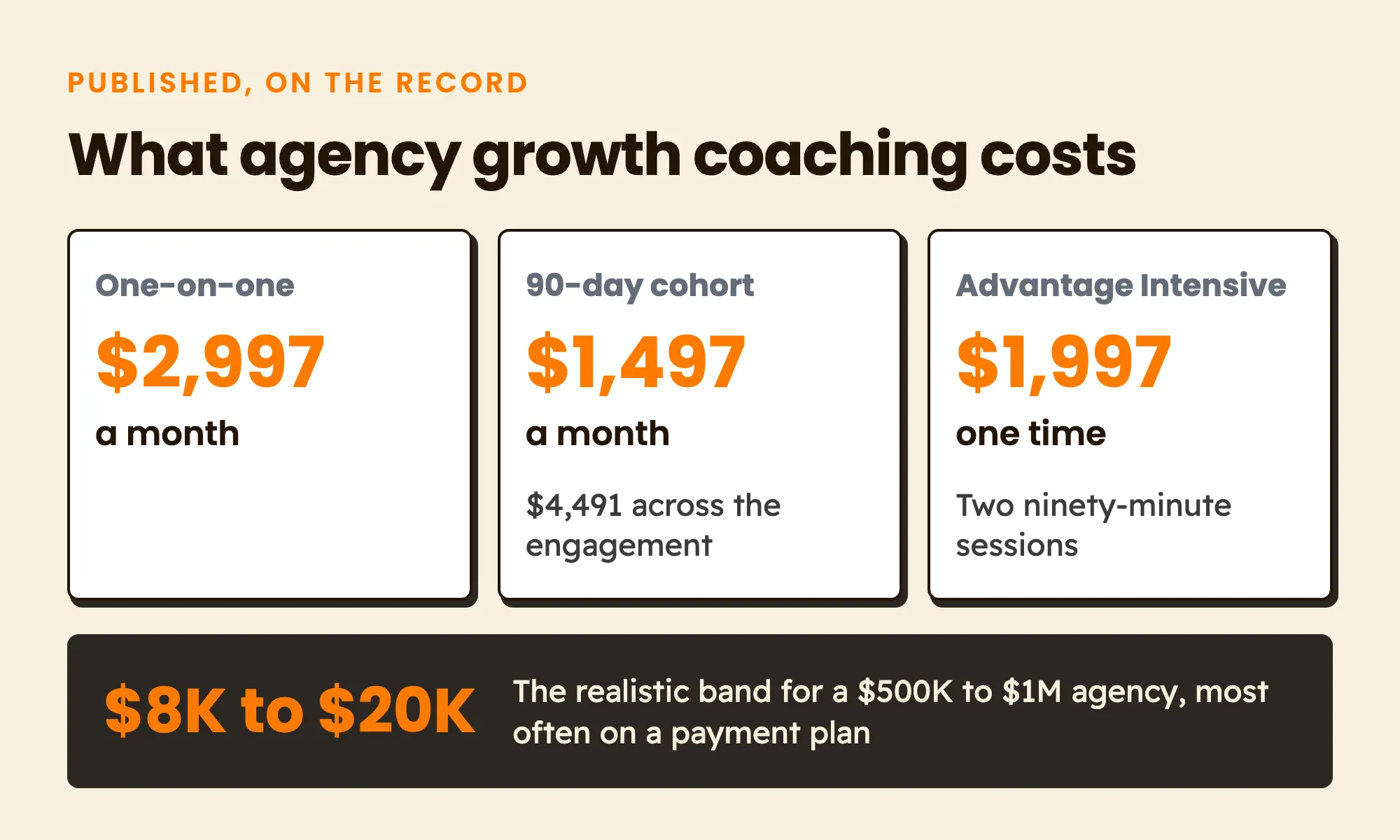
- One-on-one runs $2,997 a month. The 90-day cohort runs $1,497 a month. A one-time Advantage Intensive is $1,997.
- The realistic investment band for a $500K to $1M agency is $8K to $20K, and most get there on a payment plan rather than a single check.
- By day 90 you should have a defined buyer, a decided position, a channel you’ve worked long enough to read, and conversations arriving from something other than referrals. Revenue moves later.
- Three types of founder reliably burn the spend, and all three are visible before day one if you’re honest about which one you are.
What this covers
- What agency growth coaching actually is
- Whether coaching is even the right product
- What it costs, and why the numbers sit there
- What the guarantee covers, and what it doesn’t
- What should change across 90 days
- The six areas any real program has to cover
- How to tell a good coach from an expensive one
- Where the money gets wasted, and when not to spend it
What agency growth coaching actually is
Agency growth coaching is business coaching narrowed to one business model. The narrowing is the whole value. An agency sells time it has to staff, against scope that moves, to clients who can leave in 30 days, and almost every problem that shows up is some version of that structure biting. A generalist coach has to learn your business model before the advice means anything. A specialist already knows what your utilization number is doing to your margin and why your best client is your biggest risk.
In practice it covers positioning, offer design, sales, delivery, team and the numbers you run the place on. Good coaching is not information delivery. You can get the information free, and most owners already have more of it than they’re using. What you’re buying is someone who’ll look at your specific situation, tell you which of the six things is actually the constraint right now, and then hold you to doing something about it before the quarter ends.
The failure mode of the category is selling motion instead of outcomes. Frameworks get delivered, sessions get attended, and if nothing changes in the pipeline the client apparently didn’t implement hard enough. That leaves all the risk on the buyer, which is a strange arrangement for an industry that talks this much about confidence.
Is coaching even the right product?
Worth settling before price, because it’s a different question and it gets skipped.
A coach works on your judgment and holds you accountable to decisions you make. A consultant does the work or designs the thing for you. A mastermind gives you a room of peers and no owner of your outcome. A course gives you the information and none of the three. They’re bought interchangeably, which is why some engagements never had a chance, and the full comparison is here.
The short version: if you know what to do and aren’t doing it, you don’t need a course. If you don’t know what to do and won’t have time to execute it either way, you might need a consultant rather than a coach.
What does agency growth coaching cost?
One-on-one coaching is $2,997 a month. The 90-day cohort is $1,497 a month, so $4,491 across the engagement. The Advantage Intensive is a one-time $1,997 for two ninety-minute sessions, and it exists as the entry point for agencies that aren’t the right shape for ongoing work yet.
For context on the category, agency coaching broadly spans from a few hundred dollars a month for group programs up to five figures a month for advisory to larger shops, and most of it isn’t published anywhere you can check. That opacity is a choice, and it’s usually made because the price flexes based on what the buyer seems able to pay.
The reason to publish is that it filters. Somebody who can’t get to $2,997 a month doesn’t book, which saves both of us a call, and the people who do book arrive already past the sticker question and ready to talk about fit. It has never closed anything by itself, and I’d be wary of anyone claiming their pricing page does.
Why are the numbers set there?
Positioning sets pricing, and mine is built around being reachable for smaller agencies. If I cranked to premium rates I’d be signaling something different about who I am and who I’m for, and I’d lose the founders I’m best for, which is a bad trade even when the math on a single deal looks better.
The design constraint is the band those agencies will realistically invest, which runs about $8K to $20K. Most of them get there on a payment plan rather than a single check, because runway at that size is thin and a big lump sum competes directly with payroll. So $2,997 a month lands inside that band across a real engagement, and $1,497 a month for the cohort gives a thinner agency the same thinking at a commitment they can carry without gambling the quarter on it.
The other thing the number does is set the bar for me. At $2,997 a month, an engagement has to produce something an owner can point at, and it has to do it on a timeline they can feel, which is a healthy pressure to design against.
What does the guarantee cover, and what doesn’t it?
The 90-Day Guarantee is this: by the end of our 90 days you’ll have a marketing system that’s fully operational and fully yours, ready to bring in new conversations without leaning on referrals. If you don’t, I keep working with you until you do.
Notice what it’s pinned to. It promises a system that runs and belongs to you, which is something you can look at on day 90 rather than something either of us has to argue about. And the remedy is continued work rather than a refund, because handing back the money doesn’t fix your pipeline and finishing the job does.
Notice also what it doesn’t promise, since a guarantee that hides its limits isn’t worth much. It isn’t a revenue number. Revenue depends on your market, your close rate, your delivery capacity, and how fast you move on what we decide, and guaranteeing a figure that rests mostly on your behavior with my money would be a marketing decision rather than an honest one. I’m putting my time behind the part I control, which is whether the system exists and works.
What should change across 90 days?
The shape is consistent even though the calendar varies. The typical starting point is an agency with no clear position in the market that does know what services it can deliver, which is a more common state than owners expect and it’s why the marketing never lands.
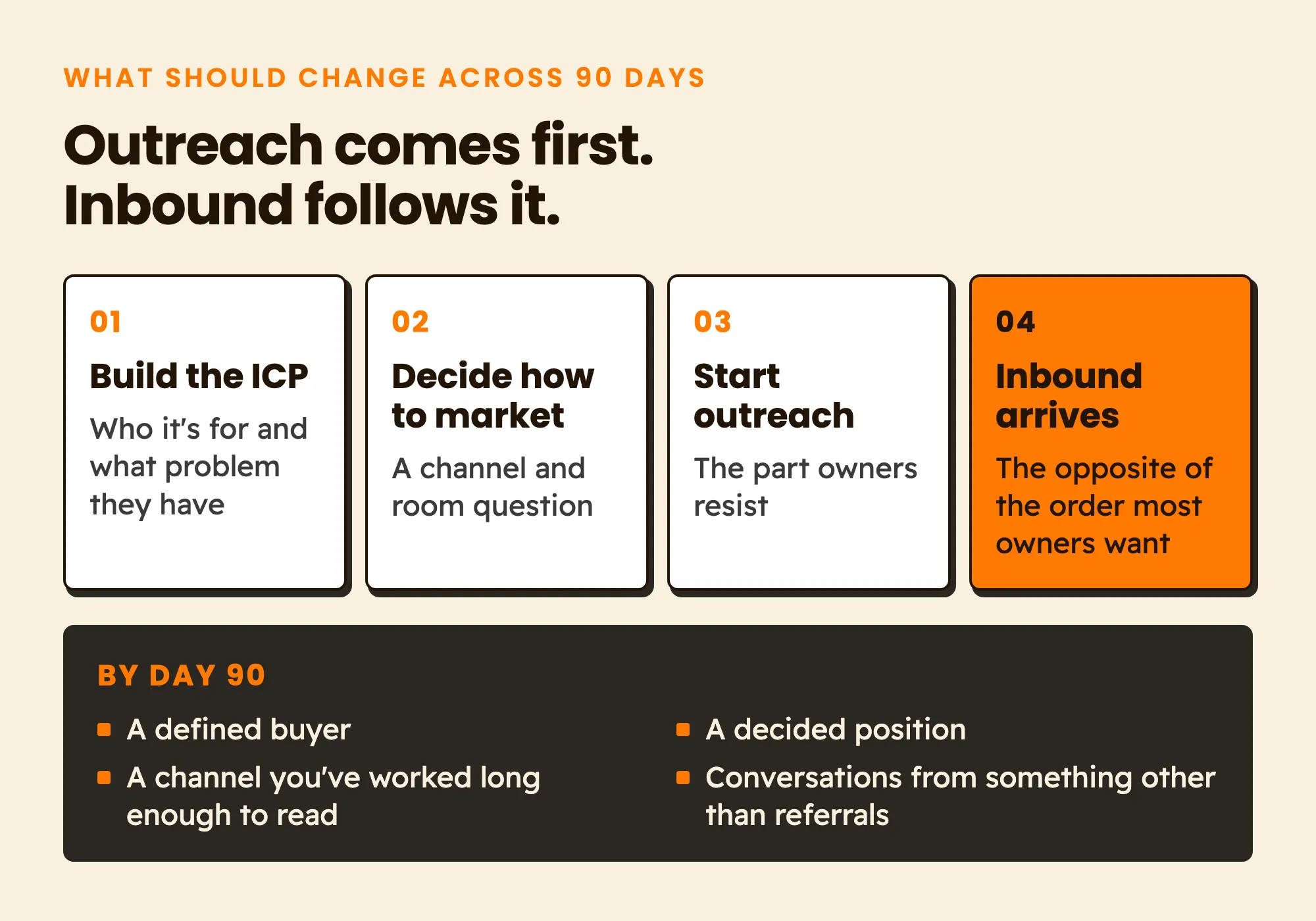
The first stretch is building the ICP, which means getting specific about who the work is for and what problem they have, because everything downstream is guesswork until that’s settled. Then it’s determining how to market to those people, which is a channel and room question rather than a content question. Then outreach starts, and outreach is the part owners resist because it’s active and uncomfortable and it’s the only thing that produces conversations you control.
What tends to happen after that is inbound starts arriving too. That sequence matters and it runs the opposite direction from what most owners want, which is inbound first so they never have to do outreach. Outreach is what produces the conversations and the pattern data that make the inbound work worth building.
So by day 90 the thing that should exist is a system that runs without you improvising it each week: a defined buyer, a decided position, a channel you’ve worked long enough to read, and conversations arriving from something other than a referral. Not necessarily a transformed revenue number, since ninety days is short for that, and a pipeline you can see is the leading indicator that the number follows.
For what it’s worth on the outcome side, the results I’ve seen from engagements include an agency going from zero to $1M ARR in nine months, another booking its second-best revenue month ever within two months of repositioning, and a founder moving from what she called a glorified freelancer to an offer that sells itself. Those are real and they’re also not promises, since they took different amounts of time and started from different places.
The six areas any real program has to cover
Skip one of these and growth stalls somewhere specific. The useful thing about the list isn’t the list, it’s that it tells you which one is your constraint this quarter.
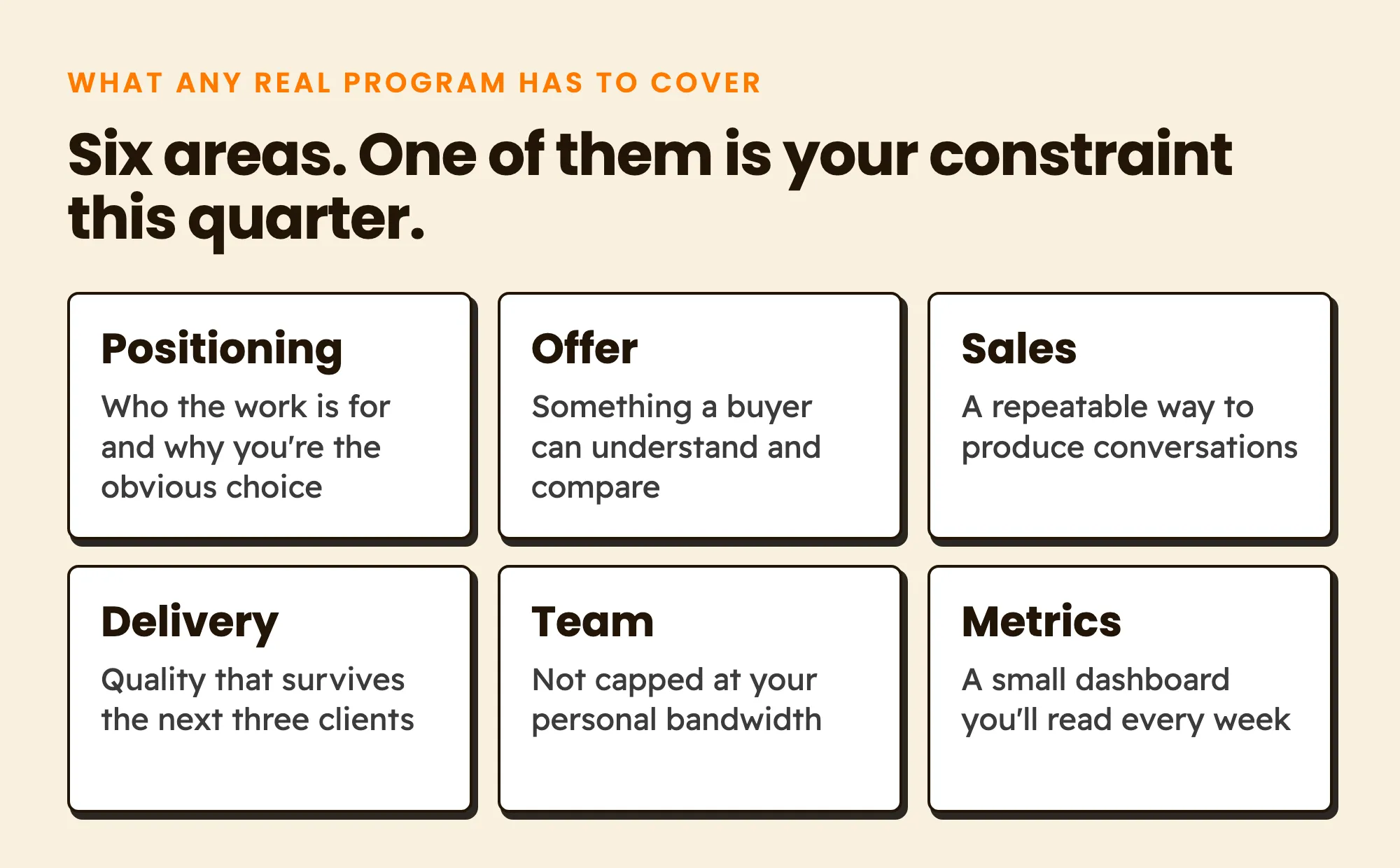
Positioning. Who the work is for and what makes you the obvious choice for them. Most agencies are too generic to be chosen on anything but price, and every downstream problem gets easier once this is decided. If your answer to what makes you different is a longer list of services, start here.
Offer. Services packaged into something a buyer can understand and compare, rather than a menu they have to design from. This is where selling outcomes instead of time actually gets built, and what makes an offer high leverage is the test to run it against.
Sales. A repeatable way to produce conversations and convert them, so the pipeline doesn’t depend on how busy you felt last month. Referrals are a great source and a terrible system, because you don’t control the volume or the timing.
Delivery. Documented workflows for onboarding, execution and reporting, so quality survives the next three clients. Chaos in delivery caps growth just as hard as an empty pipeline, and it’s harder to see coming.
Team. Roles, expectations and enough delegation that the agency isn’t capped at your personal bandwidth. Most founders hit this ceiling well before they admit it.
Metrics. The handful of numbers you actually run the place on. Not a dashboard of everything, a small one you’ll read every week.
How to tell a good coach from an expensive one
Four things worth checking, and the fourth is the one people skip.
Have they worked with agencies your size, recently? An agency at $400K and an agency at $4M have almost nothing in common operationally. Someone whose experience is all enterprise consulting will give you advice that’s correct and unusable.
Do they have a method, or just opinions? A method means they can tell you what happens in what order and why. Opinions mean every session starts from scratch and you’re paying for improvisation.
Is the price published? Not because published pricing is morally superior, but because a price that moves based on how you look on a call tells you something about how the rest of the engagement will go.
Will they tell you not to hire them? This is the real test. Any coach worth the money has a list of situations where their product is the wrong purchase, and they’ll say so out loud when you’re one of them. If everyone who books is apparently a perfect fit, you’re talking to someone whose filter is your credit card. There’s a longer version of this filter in how to choose a marketing agency coach.
Where does the coaching money get wasted?
Three founders reliably burn 90 days, and all three are identifiable in advance.
The first wants validation. They’ve already picked the path, and what they want is confirmation, so every session turns into them explaining why the thing I’m pointing at doesn’t apply to their situation. Ninety days pass and the plan is exactly what it was on day one. This is the hardest one to self-diagnose, because wanting validation feels identical to wanting advice until the advice disagrees with you.
The second wants the work done for them. Coaching only compounds when the distance between advice and action is short, and that’s precisely why I target sub-$1M agencies, since a founder that size can hear something on Tuesday and have it live by Friday without a committee. If you’re waiting for me to build it, that distance never closes and you’ve bought the wrong product.
The third is Decision Drag, and it’s the version that looks like success right up until it doesn’t. They agree with everything, take good notes, and decide nothing. The pricing change gets discussed for six months. The service line everyone agrees should be cut is still on the site at day 90. Every decision that doesn’t get made is a no that nobody said out loud, and by day 90 the engagement has turned into a very expensive conversation series.
When is “I can’t afford it” the right answer?
Sometimes it’s just true, and pushing past it is bad practice.
It’s true under $500K, because the durability problem is real at that size and one lost client can force a pause mid-engagement, which wastes the money already spent. That’s math rather than fear, and it’s exactly why the Intensive exists at $1,997 instead of pushing someone into a monthly commitment they’ll have to break.
It’s true when there’s a cash problem underneath, meaning invoicing chaos, net-60 terms by default, and receivables sitting on the founder’s desk. That needs financial stabilization before strategy, and coaching layered on top of it is a weight the business can’t hold.
And it’s the Drag talking when the money exists and the decision doesn’t. The tell is easy to spot from outside and nearly invisible from inside: affordability is the stated reason, and the same person has three other decisions sitting in the same holding pattern, none of which cost anything. That’s not a budget constraint, that’s the same unmade-decision pattern showing up in one more place.
The Monday version
Whatever you’re considering, price it against the band rather than against the monthly figure. Work out what you can genuinely commit across a full engagement, and check it against the $8K to $20K range that agencies your size typically invest. If the full engagement doesn’t fit, a shorter bounded piece of work is the right shape and a monthly commitment you’ll break isn’t.
Then run the honest version of the readiness check. Ask what you want out of it, and if the answer is confirmation of a decision you’ve already made, save the money. And ask the affordability question a second way: if this cost half as much, would you have decided by now? If the answer is no, the constraint was never the price.
If you’re an agency owner between $500K and $1M weighing this against another quarter of figuring it out yourself, come talk it through inside the Dynamic Agency Community.

Where to go next
If you’re evaluating coaches rather than reading about coaching, how to choose a marketing agency coach is the practical filter, and what a real agency growth consultant actually does covers how most of the category gets it wrong.
If you’re still working out what kind of help you need rather than who to hire, coach vs. consultant vs. mastermind vs. course separates the four. They solve different problems and get bought interchangeably, which is why some engagements never had a chance.
If referrals are still doing all the work and every month feels like a coin toss, the reactive growth trap is what that looks like from the inside, and how to move to a pipeline you control.
If you’re spread across too many services, channels and tools, optimization vs. maximization argues for focused services and deeper expertise over doing everything, and why simplicity feels scarce applies the same 80/20 thinking to your marketing.
If you’re looking at partnerships as a growth channel, go deeper, not wider explains why most of them are logo swaps that never send a lead, and the questions to ask before an agency partnership sort a real partner from a polite one before you sign anything.
If you’d rather judge your team against a number than a feeling, the revenue per FTE benchmark shows whether hiring is adding growth or just adding hours.
And if you’re at the start rather than the middle, how to start an agency: position first, then pitch is the order that saves the most rework, and how to build a scalable digital agency covers niching and automating the repeatable work so the business doesn’t run on your hours.
FAQ
How much does agency growth coaching cost?
Mine is $2,997 a month for one-on-one, $1,497 a month for the 90-day cohort, and $1,997 one-time for the Advantage Intensive. Across the category it ranges from a few hundred a month for group programs to five figures a month for advisory to larger agencies, and most of it isn’t published, which usually means the price flexes based on what you seem able to pay.
What is agency growth coaching?
Business coaching narrowed to one business model. It covers positioning, offer design, sales, delivery, team and the numbers you run on, and the narrowing is the value: a specialist already knows how an agency makes and loses money, so the advice starts useful instead of getting there in month three.
Is there a guarantee?
Yes. By the end of the 90 days you’ll have a marketing system that’s fully operational and fully yours, ready to bring in new conversations without leaning on referrals, and if you don’t, I keep working with you until you do. It’s pinned to the system existing rather than to a revenue number, because revenue depends on your market and your close rate, and the remedy is more work rather than a refund.
What should I expect to change in the first 90 days?
A defined buyer, a decided position, a channel worked long enough to read, and conversations arriving from something other than referrals. Revenue usually moves later, since ninety days is a short window for that, so the pipeline you can see is the leading indicator to judge it on.
Can I afford coaching if my agency is under $500K?
Ongoing monthly coaching usually isn’t the right fit at that size, because a single lost client can force a pause mid-engagement and waste the spend. A short bounded engagement makes more sense, and ongoing work fits once you’re past $500K with revenue steady enough to absorb some churn.
Does publishing pricing help close deals?
No, and that’s the wrong job for it. Published pricing filters, so the wrong people don’t book and the right ones arrive past the sticker question. Somebody still has to ask for the decision at the end of the call, and a pricing page has never done that part for anyone.