

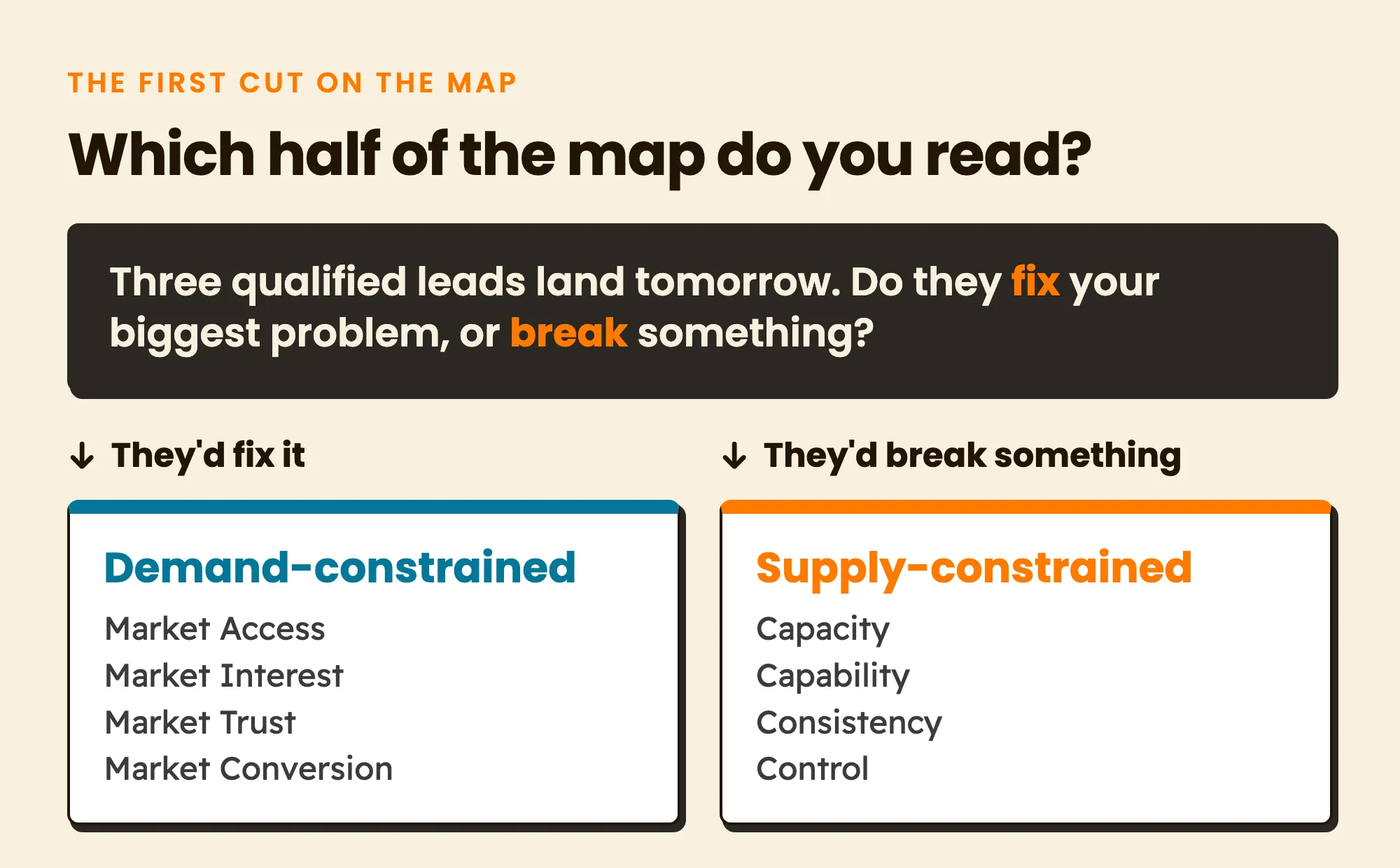
When an agency owner tells me growth has stalled, the first thing I ask is whether three qualified leads landing tomorrow would fix their biggest problem or create a new one. Most owners answer that before I finish asking it.
The answer sorts people faster than any audit I could run. If three leads would fix it, you’re starved for opportunity and everything downstream of that is basically fine. If three leads would break something, you already have more opportunity than you can hold, and pouring more in just makes next week worse. They know which one they are instantly, and a good number of them have spent the entire quarter working on the other side.
The symptom you feel is almost never the thing that’s broken, so the fix you reach for is usually one level too high. An agency spends three months rewriting its messaging when the real limit is that it has nowhere to put the message. Another one hires two people when the real limit is that there’s no documented way for those people to work. A third builds a content engine when the offer isn’t pressing on anything urgent enough to pull demand in the first place. None of that work is wrong, exactly. It’s just not the constraint, and work that isn’t aimed at the constraint burns a quarter without changing the number.
The Agency Constraint Map is a diagnostic that sorts every agency growth problem into one of eight constraints across two buckets, demand and supply, so you can find the single bottleneck capping your growth instead of treating symptoms. The four demand constraints are Market Access, Market Interest, Market Trust, and Market Conversion. The four supply constraints are Capacity, Capability, Consistency, and Control.
Quick Take
- Start with one question: do you need more opportunities flowing toward you, or can’t you handle the ones you’ve already got? Demand or supply, and everything else is downstream of that answer.
- You almost certainly have more than one constraint live right now, and only one of them is the bottleneck. The rest can wait, and the waiting is the hard part.
- Non-constraints are what eat your year, because they’re the easiest things to see and the most satisfying things to fix.
- Constraints aren’t a sequence. Sometimes you have to shore up a downstream problem first, because scaling visibility on top of a weak trust foundation just shows more people the weak foundation.
- Even a wrong diagnosis pursued with focus beats a right diagnosis spread across fifteen initiatives, so being unsure isn’t a reason to keep doing everything.
What this covers
1. Where the Theory of Constraints came from and how to run it on an agency
2. How to use the map (the demand-or-supply cut, and the dependency check)
3. The four demand constraints: Market Access, Market Interest, Market Trust, Market Conversion
4. The four supply constraints: Capacity, Capability, Consistency, Control
5. How each constraint shows up, what it costs you, and how to remove it
6. How to pressure-test your diagnosis before you commit a quarter to it
There’s no 47-step system here and nobody’s going to tell you to work harder. This is a decision tree that makes you look at your business honestly and name the choke point, because once it’s named you can remove it, and once you remove it the business grows until it hits the next one.
What is the Theory of Constraints, and why does it apply to an agency?
The Theory of Constraints says every system has exactly one limit on its output at any given time, and improving anything other than that limit changes nothing. Eliyahu Goldratt introduced it in his 1984 business novel The Goal, originally for manufacturing plants, and the observation that made it famous was that factories were pouring money into machines that were already faster than the bottleneck could absorb.
The chain version is the one everybody remembers. A chain is as strong as its weakest link, so you can reinforce every other link until it’s indestructible and the chain still snaps at fifty pounds because one link was rated for fifty pounds. Everything you did to the other links was real work that produced zero result.
Your agency runs on the same math. Right now there’s one thing capping your growth, and it might be that you can’t reach enough of the right people, or that they see you and feel nothing, or that you can’t deliver the quality you’ve been selling. Whatever it is, most of what’s on your list this week probably isn’t it. The website looks dated so you’re redesigning it, the proposals feel generic so you’re rewriting them, and the team seems tired so you bought everyone standing desks. All of that might need doing at some point, and none of it moves growth if it isn’t the constraint. Your house is on fire and you’re organizing the junk drawer.
So you name the one thing, you point everything at it, and you don’t stop until it isn’t the bottleneck anymore. Then a new constraint surfaces, which is the part that frustrates people the first time through. You fix access and discover a trust problem, or you fix capacity and immediately find a consistency problem underneath it, and it starts to feel like the business is never finished, and that’s because it isn’t. A new constraint appearing means you removed the old one, and the new one was there the whole time, hiding behind the bigger thing that was choking everything.
One caveat that matters more than it sounds: this isn’t a fixed order, and constraints interact. If your trust fundamentals are broken (no proof, no credibility, nobody’s heard of you), scaling access just means more people see the weak hand. You’ll buy visibility and reputation damage in the same purchase. So treat this as a diagnostic rather than a checklist, and watch for dependencies while you’re picking. Sometimes the right first move is the smaller constraint, because it’s a prerequisite for the bigger one.
What doesn’t change is that focus beats diffusion. The alternative is what most agencies do, which is run at positioning and service design and hiring and content and sales process all at once, spreading effort across fifteen initiatives until none of them get enough attention to produce a result. I’ve done this. It feels like progress right up until you look at the quarter and can’t point to a single thing that finished.
How do I use the constraint map?
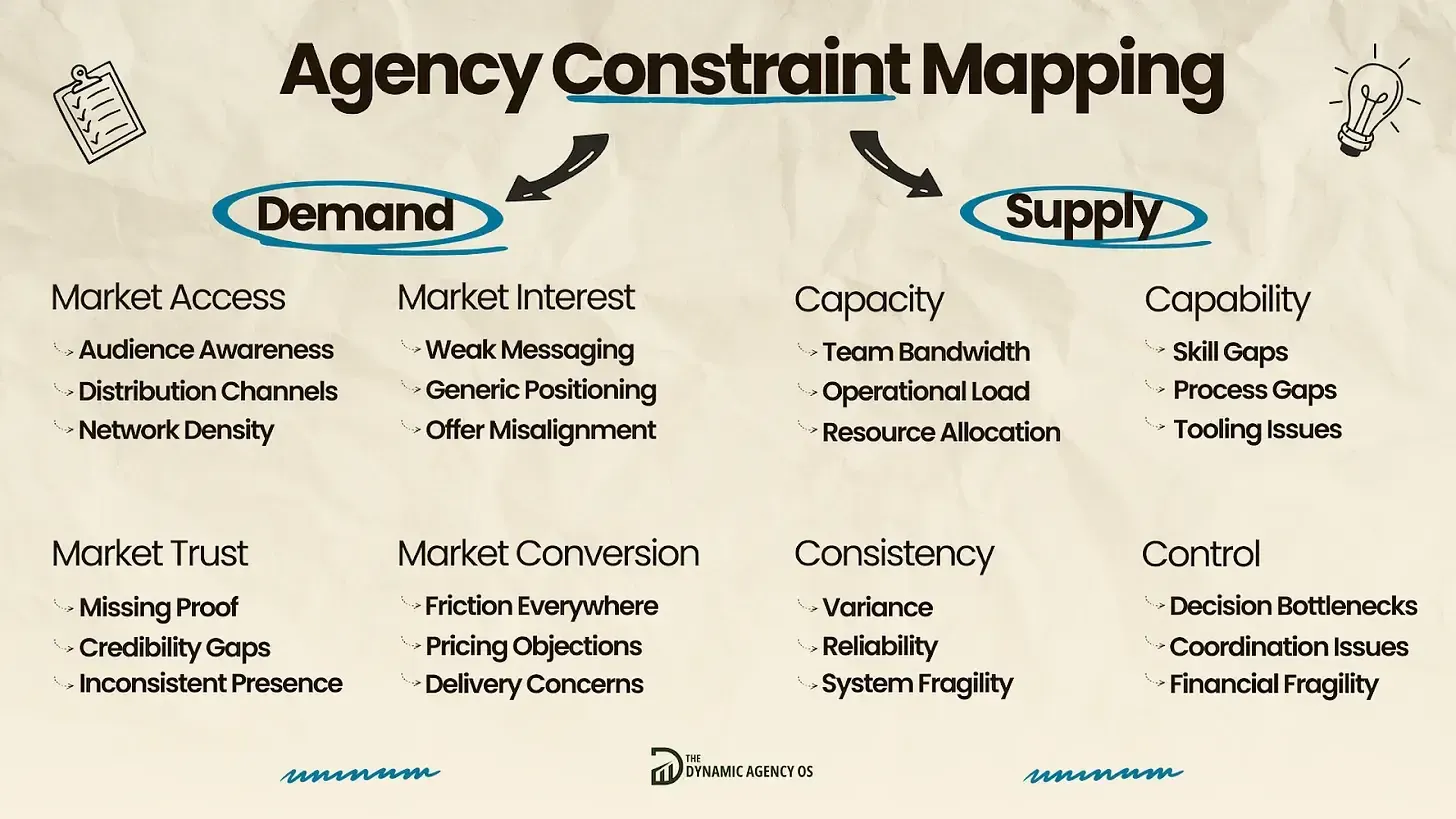
Start at the top with one cut: is this a demand problem or a supply problem? If you need more opportunities and conversations flowing toward you, it’s demand. If you have opportunities and can’t handle them, or can’t scale the operation behind them, it’s supply.
Most owners already know instinctively, because you’re either hungry for deals or drowning in work. If you’re not sure, run the three-leads question from the top of this article. If those leads would solve your problem, you’re on the demand side, and if they’d create chaos, you’re on the supply side.
Once you know your side of the map, you follow the branches. Demand splits into Market Access, Market Interest, Market Trust, and Market Conversion. Supply splits into Capacity, Capability, Consistency, and Control. Each one has its own symptoms, and as you read them one is going to feel more real than the others. That recognition is the diagnosis, and it’s usually accurate.
Then you pick one and hammer it until it breaks, because you can’t fix all eight simultaneously and trying is exactly how agencies spend a year spinning.
But “one at a time” isn’t the same as “in order.” The demand constraints aren’t a funnel you walk down, and neither are the supply ones. Say you diagnose Market Access as primary, you’re not reaching enough people, and that read is correct. Then you look at your trust situation and find zero case studies, no demonstrated expertise, and a website that looks like it was built in 2015. Scaling visibility right now shows a bigger audience a weaker hand, so the smarter move is to get the trust basics in place first even though trust isn’t technically your primary constraint. Build two case studies, clean up the site, publish something that proves you know what you’re talking about, and then open the tap.
So the diagnostic question is really two questions. What’s my biggest constraint, and what has to be true before I can fix it without making things worse?
The constraint you have today won’t be the constraint you have in six months, and that’s the system working. Read the demand section if you need more opportunity. Read the supply section if you can’t handle what you already have. Find the one that makes you say “yeah, that’s us,” and go remove it.
The four demand constraints
Demand isn’t traffic, impressions, or people who might care someday. Demand is a person with a problem they’re actively trying to solve, looking for something that solves it. The problem and the urgency already exist in the market, and your job is to pull that existing demand toward you as the answer.
That distinction matters because a lot of agencies believe their job is to create demand. You can’t create demand without first creating the problem, and manufacturing problems to sell solutions is both manipulative and short-lived. What you’re doing is making people aware you exist as a solution to something they already feel.
Healthy demand looks like a steady flow of qualified prospects reaching out, engaging, or getting introduced to you, through whatever motion fits your market: inbound, outbound, paid, events, partnerships. You’re having enough sales conversations that closing 30 to 40 percent of them hits your revenue target, and you’re not lying awake wondering where next month’s client comes from.
Unhealthy demand is feast or famine. Long dry spells, then three deals land in the same week. Or the worse version, where you’re busy and visible and the conversations still aren’t happening, or they’re happening with people who were never going to buy.
There are four ways demand breaks. As you read them, one is going to feel more acute than the others, and that’s where you start.
Market Access: can enough of the right people even hear you?
Market Access is the constraint where not enough of your target buyers are reachable, so the message never gets in front of a big enough audience to matter. It’s the simplest of the eight to understand and one of the harder ones to fix, because the fix sometimes means admitting you picked a market you can’t get to.
I’ve watched agencies choose a niche they have no access to more times than I can count. The audience sounds great on paper and turns out to be locked behind a door they can’t find. It’s like deciding to serve a market that meets in a speakeasy when you don’t know the password, don’t know which building it’s in, and don’t know anyone who can walk you in.
This is a different problem from messaging or positioning, which are about what you say once you have the room. Access is about whether the room exists. You can have the sharpest positioning in your category and it changes nothing if you’re saying it into an empty space. Agencies get stuck here more often than they realize, spending months perfecting a website, refining case studies, and workshopping a pitch deck, then launching all of it into the void and wondering why nothing happened. The build was fine, and there was nobody in the room to see it.
How Market Access constraints show up
Audience awareness. You either haven’t defined your ICP or you’ve defined it so broadly that everyone technically qualifies, which means nobody does. “B2B companies that need help with marketing” describes something like 47 million businesses, so that’s a census category rather than an ICP. The tells are specific: you can’t name ten real companies that would be perfect clients, your answer to “who do you serve” changes depending on who’s asking, and you chase whatever walks in the door because you never decided who you’re for.
The other version is that you’ve named a target and don’t actually know them. You can’t say which conferences they attend, what they read, which Slack groups or subreddits they ask for recommendations in, or who they trust when they’re making this kind of call. You’ve picked an audience without mapping where that audience lives, which leaves you with a label instead of a route. Five things have to be answerable with specifics: who you serve, where they gather, what they read, who they trust, and how they decide to buy. Vague on any of them and this is your problem.
Distribution channels. Here the problem is a mismatch between where you publish and where your buyers look. You’re posting on LinkedIn three times a week aiming at Fortune 500 CIOs who don’t pick vendors from LinkedIn posts, or making TikToks for people who decide in boardrooms, or writing threads for an industry that barely uses social. You’re technically in public, which is not the same as being in the room where the buying happens.
Sometimes the mismatch runs deeper than platform choice. Your buyers might not be looking on social at all. They might be typing questions into Google, asking in a private industry Slack, or reading a trade publication you’ve never opened. You built the whole distribution plan around a channel your audience doesn’t use for this decision.
Then there’s referral dependence, which feels wonderful until you notice you have no control over your own pipeline. Every deal arrives because someone else decided to send it, your growth ceiling is the size and generosity of other people’s networks, and your forecast is “hopefully Greg from that conference remembers I exist.” Referrals are a great supplement and a terrible strategy.
Network density. This one runs on relationships, and the symptom is that your world is too small. No partnerships, no alliances, no account-based plan, no deliberate relationship building. You don’t know the other consultants and agencies serving your audience next door to you, you have no relationship with the software vendors your buyers already pay, and when you need an introduction there’s nobody obvious to ask.
It also shows up as deals that pass you by. You hear about a perfect-fit prospect a week after they signed with someone else. A contact who could have referred you didn’t, because they had no idea that’s what you were looking for. Opportunity is moving through your market, just not through you.
This is where a lot of owners get defensive, and it usually sounds like “I’m not a schmoozer,” or “I don’t believe in networking for networking’s sake,” or “my work should speak for itself.” Your work is speaking. Nobody’s in the room. Meanwhile the competitor building relationships with adjacent providers, platforms, and associations is eating your lunch, and they’re not better than you at the work. Network density isn’t about being fake, it’s about the fact that most buying decisions still travel through warm introductions, so refusing to build them means choosing the hardest possible path to the same outcome.
Why Market Access matters more than anything downstream of it
If access is your constraint, nothing else you improve will scale, because everything else multiplies against a number that’s too small.
You can have the strongest positioning, the best case studies, and the sharpest offer in your category, and if twelve people a month encounter any of it, your ceiling is set. Access sits upstream of the whole thing: you can’t test messaging nobody sees, can’t build trust without visibility, and can’t convert conversations you never had.
This is also the most commonly misdiagnosed constraint on the demand side, because low deal flow feels like a sales problem. Owners tell me they need to get better at closing, and then it turns out they’re having two or three sales conversations a month. Nobody closes their way out of that.
The math makes it obvious. The Ehrenberg-Bass Institute’s 95-5 rule, from Professor John Dawes’ work on B2B buying, holds that only about 5 percent of your potential buyers are in market at any given time. So a market of 10,000 gives you roughly 500 people actively looking. You won’t win all of them, because you have competitors and the status quo to beat, but win a conservative 3 percent and that’s 15 opportunities. At a 30 percent close rate, that’s about 5 new clients, and unless you’re selling sub-$1K packages, most agencies would take that month happily. Now cut your reach in half because you can only get to a fraction of that market, and the same math turns thin. Access is how you stop leaving most of your addressable market untouched.
How to fix Market Access
You get out of this by building repeatable discovery mechanisms, meaning systems that put you in front of your ICP on purpose rather than by luck. Before you build any of them, though, answer an honest question: is the market you picked actually reachable by you? If you’re aiming at enterprise CFOs with no enterprise experience, no network in that world, and no platform they pay attention to, the fix might not be better distribution. It might be a different audience, and that’s just arithmetic.
Fixing audience awareness. Get concrete about who you serve, and not at the industry-category level. Name ten companies that would be perfect clients, name the titles of the people who sign, and describe what’s happening inside those businesses right now that makes them need you. If you can’t do all three, you don’t have an ICP yet, you have a hunch, and that’s the first thing to fix.
Then map where those people actually are, using evidence instead of assumption. Ask your best past clients where they go when they’re trying to solve the problem you solved, what they read, what communities they’re in, which events they attend, and who they ask for recommendations. Keep going until the five questions (who, where, what, who they trust, how they buy) all have specific answers. If you finish that work and find your audience lives entirely behind doors you can’t open, you have a real choice: build access slowly through relationships and credibility, or pick a market you can reach. Both of those are legitimate, and picking an unreachable audience and hoping isn’t.
Fixing distribution channels. The correction here is relocation before intensification. If your buyers aren’t on LinkedIn, posting more on LinkedIn won’t help, and if they’re searching Google, you need to be findable in Google. Audit where your buyers look for solutions, compare that honestly to where you’re currently spending your energy, and go where the gap is, even when it’s unfamiliar.
Being in the right place isn’t sufficient on its own, because every channel has its own rules. LinkedIn rewards specific formats and engagement patterns, Google requires understanding search intent, paid media on Meta behaves nothing like paid on LinkedIn, and communities have unwritten norms that decide whether you’re welcome or ignored. If your buyers are somewhere you don’t understand, you either learn it or hire it. Learning means a course and real study time. Hiring means a contractor or team member who already knows, which is faster and more expensive and gives you another person to manage. What doesn’t work is showing up in the right room and working it badly.
And if you’re living on referrals, build one channel you control. Just one, in a place your buyers already look, with a real presence rather than a token one.
Fixing network density. Start with who already has access to your buyers, and skip competitors. Look at adjacent providers serving the same ICP with complementary services, the technology vendors those buyers use, the consultants they hire, the associations they join. Build a list of 20 to 30 and start real relationships, which means being useful over time rather than opening with a referral agreement. Some become sources, most won’t, and that’s fine because you’re building density rather than collecting cards.
Then get into the rooms, whether that’s associations, online communities, conference circuits, or peer groups, because you can’t build a relationship with someone you never encounter. And make yourself easy to refer by telling your network exactly who you’re looking for. When someone asks who you help, the answer should be short enough to repeat and specific enough to trigger a name. The question to sit with is simple: who in my network could introduce me to my ideal clients? If the answer is nobody, that’s the work. If the answer is “several people, but they never send anything,” the work is making it easier for them to think of you at the moment it counts.
Market Interest: people can see you and don’t care
Market Interest is the constraint where you have visibility and distribution, and the audience scrolls past anyway, because what you’re saying doesn’t connect to anything they’re feeling. Access is whether they can find you. Interest is whether they give a damn once they have.
This one is demoralizing in a way the others aren’t, because it feels personal. You’re putting yourself out there and the market is collectively shrugging. Most of the time, though, the shrug is about a mismatch between what you’re saying and what your buyer currently cares about.
How Market Interest constraints show up
Weak messaging. You haven’t named a problem clearly or made a promise that lands, so you sound like the other fifteen agencies in the consideration set. It usually reads like “we help companies grow through strategic marketing,” or “we create brand experiences,” or “we drive results through data-driven campaigns.” Every one of those is technically true and completely interchangeable.
Strong messaging does three jobs at once: it names a specific problem your ICP is living with, it promises a specific outcome they want, and it does both in language that’s recognizably yours. The test is whether your core message could be pasted onto a competitor’s site without anyone noticing. The second test is whether a buyer hears it and immediately knows whether it’s for them, because “maybe, tell me more” means it isn’t sharp yet. Good messaging repels as efficiently as it attracts, and the wrong people saying “not for me” is the system working.
Weak positioning. Messaging is what you say, positioning is what you’re known for, and diffuse positioning is a business problem rather than a marketing one.
The visible symptom is the services page listing eight to twelve offerings: SEO, paid, content, social, email, automation, web development, brand strategy. The logic is that being full-service means never turning anyone away, and the result is that nobody knows what to hire you for.
It runs deeper than that page, though. It shows up in how your team decides things, because without a clear position every opportunity looks reasonable, every service expansion seems defensible, and every client request feels like a yes. There’s no filter to apply, so you chase everything and build nothing. It shows up as inconsistency, where the proposal doesn’t sound like the website, which doesn’t sound like your LinkedIn, and three team members describe the company three different ways. Prospects feel that even when they can’t name it, and what it reads as is an agency that isn’t sure who it is. And it shows up in operations, because you can’t build repeatable delivery when every project is different, can’t develop depth when you’re spread across six disciplines, and can’t hire well when you don’t know what capability you’re building toward.
Strong positioning costs you something by design. It doesn’t mean offering one service, it means that when someone thinks of you, they think of you against one type of problem. If nobody can describe what you do in a single differentiating sentence, the position is too weak to generate interest.
The other pattern I see constantly is agencies trying to be clever instead of clear. “We’re not your typical agency.” “We color outside the lines.” “We break the rules.” Every agency website in 2016 said that, and it wasn’t differentiating then either. The question that matters is what problem you solve better than anyone else, and clarity generates interest where cleverness generates a polite nod.
Offer misalignment. You’re selling something your ICP doesn’t want, doesn’t understand, or doesn’t consider urgent.
Sometimes that’s complexity. There are too many moving pieces, too many options, too much customization required before anyone can tell what they’d be buying. A buyer needs to know what they get, what it costs, and what result to expect, and if any of those needs a thirty-minute call to explain, the offer’s too complicated. Sometimes it’s structural, where retainers feel risky because there’s no endpoint, projects feel risky because scope could explode, and packages feel arbitrary because the tiers don’t map to anything the buyer recognizes.
The most common version is the vitamin problem, where you’re selling nice-to-have into a market that only buys need-to-have. You’re offering brand strategy to someone whose boss is asking why pipeline is down 30 percent. The outcome you’re promising might be valuable and still lose, because it isn’t urgent enough to act on this quarter.
Why Market Interest matters
You can have perfect access and still fail, because interest is the bridge between visibility and engagement, and without it visibility is just noise you’re paying for.
I’ve watched agencies spend months on content, ads, and outreach, generating thousands of impressions, and the engagement data is a graveyard. Click-through is low, bounce is high, nobody replies to the outreach, and no inbound arrives, which means the market saw them and felt nothing.
The reframe that helps most: you’re not competing against other agencies for attention, you’re competing against inertia. Your ICP is busy, distracted, and dealing with whatever’s on fire today. They’re not lying awake thinking about their marketing, and they’re not shopping. So if the message doesn’t grab them, the position doesn’t make you memorable, and the offer doesn’t press on something urgent, they scroll. Not because you’re bad, but because you didn’t give them a reason to stop.
How to fix Market Interest
Everything here gets easier when you get more specific about who you serve and what problem you solve, and then more specific than that.
Fixing weak messaging. Talk to your ICP, and I mean actually talk to them rather than imagining them. Ask what they’re dealing with, what they’ve already tried that didn’t work, what they wish existed. Listen for the language, the urgency, and the outcomes they name themselves. If you can’t get conversations, mine voice of customer wherever it already exists: reviews of competing services, complaints in the communities they’re in, transcripts and notes from your own past sales calls.
Then use their words rather than your translation of their words. If they say they’re “struggling to get qualified demos booked,” don’t turn that into “optimizing conversion funnels.” Name the problem the way they experience it, not the way you diagnose it.
One structure that works is problem, outcome, method, in that order. “Most agencies struggle to get off the referral treadmill. We help you build a pipeline you control through positioning work that makes you the obvious choice in your market.” Then pressure-test it by taking any claim and asking “so what” until you hit something the buyer cares about. “We create great content.” So what? “It drives traffic.” So what? “Traffic turns into leads.” So what? “You hit your pipeline targets without paying for ads.” Most agency messaging stops two rungs early.
Another angle is contrast, where you describe the painful current state, describe the future state, and position the work as the bridge. It works because it proves you understand their Tuesday before you start listing deliverables. The bar for the finished message is whether you can say it out loud to someone in your ICP and watch them nod and say “yes, that’s exactly my problem.” Anything short of that recognition, keep cutting.
Fixing weak positioning. Pick one problem you solve better than anyone and make that your entire external identity for the next year. Not three problems, one. This doesn’t mean dropping your other services, it means that publicly you’re known for one thing: your content is about it, your case studies feature it, your outreach leads with it.
The sharpest test I know is the “only” test, which is whether you can honestly complete the sentence “we’re the only agency that ___.” If you can’t, keep narrowing until you can make a credible only-claim. Maybe you’re the only one in a vertical, or the only one with a specific methodology, or the only one guaranteeing a specific outcome. Most agencies find their only-claim requires stacking several points of differentiation rather than owning one, which is a longer piece of work and worth doing properly.
You can also position against the alternative. There’s a most-common substitute for hiring you, whether that’s a generalist agency, an in-house hire, or doing nothing, and that substitute has a weakness your approach specifically solves. Name it, and you’re positioning against something instead of floating in space.
If you’re worried about leaving money on the table, don’t be. Agencies that stand for one thing get hired for many things, and agencies that stand for many things struggle to get hired at all, because specificity reads as competence and generalist positioning reads as availability. Then strip the clever language out. “We help B2B SaaS companies generate qualified pipeline through content” beats “we’re a creative agency that thinks differently about growth” every single time.
Fixing offer misalignment. Figure out what your ICP is trying to fix this quarter, not what you think they should be fixing, and build the offer around that outcome. If they need leads, promise leads. If they need conversion, promise conversion. Selling them the strategic work you believe they need when they’re not shopping for strategy is a losing sequence even when you’re right.
The mental shift that helps is jobs to be done, from Clayton Christensen’s work at Harvard Business School: your ICP isn’t buying your service, they’re hiring it to do a job. And the job isn’t “produce content” or “run ads,” it’s generate pipeline so I hit my number, look competent to my board, and stop worrying about where next month’s clients come from. Build around the job, not the deliverables.
Then run the offer through the “would they pay today” test. Not eventually, not once they understand the value, today. A no means you’re not pressing on anything urgent enough, so either find a more urgent problem or reframe the offer to connect to something already keeping them up.
When you package it, lead with outcomes rather than activities, because “12 blog posts a month, weekly reporting, quarterly strategy sessions” invites line-item negotiation while “a content engine that produces 50+ qualified leads a quarter” invites a value decision. Simplify the structure until you can explain what they’re buying, what it costs, and what they get in three sentences. And find the primary objection, then build a mechanism that neutralizes it: performance concerns get a guarantee, commitment concerns get a shorter first engagement, fit concerns get a paid diagnostic before the full thing. Every offer has one main reason people hesitate, and most agencies have never named theirs.
Market Trust: they believe the category and don’t believe you yet
Market Trust is the constraint where buyers are interested and still won’t commit, because nothing you’ve published proves you can do what you’re claiming. It’s sneaky, because on the surface everything looks healthy. People find you, they understand the problem you solve, and they might even agree out loud that they need help with it.
Then when it’s time to book the call or sign the thing, they hesitate, they need to think about it, and eventually they stop replying. This constraint lives in the gap between interest and action, where somebody can be intellectually convinced they need what you offer and emotionally unconvinced that you’re the one to provide it.
How Market Trust constraints show up
Missing proof. The obvious version is having no case studies, no specific testimonials, and no results anybody cares about. You might have endorsements along the lines of “great to work with” and “highly recommend,” which read like Yelp reviews for a decent sandwich shop and prove nothing.
Buyers are trying to answer three questions: has this agency done this before, did it work, and can they do it for me. Unanswered questions kill deals, and generic proof leaves all three unanswered. “We helped a SaaS company increase leads by 40 percent” beats silence and still isn’t proof that you can help this SaaS company with this problem. Strong proof carries the situation, the approach, the specific result, and enough texture that it reads as real. Testimonials work the same way, where “Acme was great to work with” tells a buyer nothing about competence and “Acme helped us clarify our positioning, which tripled qualified inbound over six months” tells them something they can act on.
There’s a subtler version too, where you have decent proof for the wrong outcomes. You want to be known for demand generation and every case study is brand work. You want enterprise clients and every proof point is a startup. The evidence exists and it doesn’t match what you’re asking to be hired for.
Credibility gaps. The most common one is expertise that’s claimed and never demonstrated. You say you’re experts in B2B SaaS marketing and your content is generic marketing tips that could run in any industry. You claim to specialize in paid media and nothing you’ve published shows you understand paid beyond surface tactics. You labeled yourself an expert without ever showing the work, and claiming expertise without demonstrating it is noise.
Another version is the absence of third-party validation, where you’re the only one saying you’re good at this. Nobody’s co-signing, you haven’t been featured anywhere your ICP reads, you’re not speaking where they gather, nobody quotes you. Your claims exist in a vacuum. There’s also the invisible track record, where prospects want to know you’ve done this before and your LinkedIn is a list of job titles rather than a story, and your website shows no trajectory connecting who you are today to the experience that qualifies you.
Basic professionalism counts too. A dated site, typos in the copy, a team page of headshots with no context, all of it erodes trust before you get a chance to demonstrate anything. That’s just about looking like you take yourself seriously. Although a polished brand with no demonstrated expertise is just a nice-looking empty box.
Inconsistent presence. You show up in sprints and then disappear for months, your thought leadership arrives when you feel inspired, and your messaging drifts like you’re working it out in public.
Buyers read inconsistency as instability. If your content is erratic, they assume your delivery might be, and if your positioning changes every few months, they wonder whether you know what you’re doing. Trust is built through predictability, which in practice means repetition, and one brilliant post doesn’t build it where a year of showing up does. The post-twelve-times-in-January-then-vanish-until-April approach signals that you might not be around when they need you.
Why Market Trust matters
You can have people interested and lose every deal anyway, because trust is the last gate before yes. Without it buyers find reasons to delay, keep looking, or pick the competitor who feels safer.
The economics are brutal in a specific way: you’re generating interest and having conversations, and none of them convert. You’re spending real hours on calls with people engaged enough to take a meeting and not engaged enough to take a next step.
The other thing that makes this constraint painful is that it takes longer to fix than access or interest. You can’t manufacture trust in a month, because it requires a body of proof, external validation, and visible consistency over time. That’s why agencies with trust problems so often go work on access or interest instead. Those feel faster, and speed isn’t the same as progress.
How to fix Market Trust
Trust gets rebuilt through authority assets and outside validation, accumulated on purpose. It takes time and there’s no shortcut, but it’s straightforward if you commit.
Fixing missing proof. Document your wins as full stories rather than outcomes: where the client was before, what approach you took, what specific results landed, and what those results meant for their business. If you don’t have strong results yet, that’s a different problem, and it might mean taking a couple of projects at reduced rates specifically to generate proof, or getting more disciplined about tracking outcomes on work you’re already doing. Most agencies have proof and never captured it.
For testimonials, stop accepting generic praise. When a client says “great work,” follow up with real questions: what specific outcome did we help you get, what was different about working with us, what would you tell someone considering us? Record it and use it.
Make sure the proof matches the position, so demand generation positioning gets demand generation case studies and enterprise targeting gets enterprise logos. Mismatched proof creates doubt rather than confidence. And if you’re entering a new market with no proof yet, borrow credibility while you build your own: feature guest experts, cite named research, reference recognized authorities. Brand is largely association, so proximity to credible names helps, and it’s weaker than your own track record but stronger than nothing.
Fixing credibility gaps. Demonstrate expertise instead of claiming it. Write about your methodology, publish the thinking behind how you approach problems, break down real situations and explain the reasoning. Go deep enough that only someone who’s actually done the work could have written it. You’re not giving away secrets, you’re showing enough of your thinking that a prospect reads it and thinks “this person gets it.” Generic content that anyone could have written does nothing here.
Close the third-party gap by getting into places your ICP already trusts, whether that’s their publications, their podcasts, their conferences, or their communities. External validation moves trust faster than self-promotion because somebody else is vouching. That takes months to build, so start now: pitch podcasts, submit articles, apply to speak, join communities and contribute before you promote anything.
Make the track record visible. Your LinkedIn should tell the story of your experience rather than list positions, your site should connect where you’ve been to why you’re qualified for what you’re selling now, and your team page should explain why each person is credible for this work instead of listing names and titles. And invest in the basics, meaning a clean site, tight error-free copy, and a coherent visual identity. Not expensive, just intentional. Professionalism gets you in the door and demonstrated expertise is what keeps you in the room.
Fixing inconsistent presence. Pick your channels and show up on a predictable cadence, which doesn’t mean daily and does mean rhythmic. Weekly beats sporadic, biweekly beats nothing, and the point is that people come to expect you and you deliver on it.
Commit to your positioning for at least a year, and stop testing new messages every month. Repetition feels stale to you because you’re saying it constantly, and your market is hearing it for the first time, whenever they happen to run into you.
One more thing that helps: lower the barrier to the first engagement. If trust is the constraint, don’t ask for a $50K commitment out of the gate. Offer a workshop, a diagnostic, a paid strategy session, something that lets them experience working with you at low stakes, because trust compounds fast once someone has seen you deliver.
Market Conversion: they want the outcome and can’t get through your process
Market Conversion is the constraint where everything upstream works and deals still don’t close, because the path from interest to signature has too much friction, unclear pricing, or unaddressed delivery risk.
This is the most maddening one, because you’re so close. They found you, they care, they trust you enough to take a call. And then the deal stalls, the prospect stops replying, they need to think about it, and the thing dies of natural causes.
How Market Conversion constraints show up
Friction everywhere. The path from “I’m interested” to “I’m in” is too slow, too complicated, or too confusing, and it usually starts with the basics. Someone raises their hand and gets sent to a booking link that asks for five fields of information you could have gathered on the call. Or they book and the first opening is two weeks out because your calendar is a disaster. Or they book and never get a confirmation because the automation broke and nobody checked.
Then there’s discovery itself, where you jump on a call with no structure, no agenda, and no defined outcome, spend forty minutes learning about their business, promise a proposal, and take a week to send it. By the time it lands, the urgency has cooled and they’ve moved on.
The opposite failure is just as common. There’s a discovery call, then a deeper discovery call, then a scoping meeting, then a proposal review, then a negotiation, and each step adds a week or two until a two-week close takes six. Every additional week is another chance for the deal to die of something unrelated to you.
Friction hides in qualification too. You’re either not qualifying at all, so you’re writing proposals for people who were never going to buy, or you’re over-qualifying and screening out good-fit prospects who don’t match your ideal profile perfectly. Both burn the same hours.
Pricing objections. These usually have nothing to do with being expensive, and everything to do with pricing that doesn’t make sense to the buyer or a structure that creates doubt instead of confidence.
Sometimes it’s a value mismatch, where you’re charging $10K a month for something that feels like $5K work and you haven’t built enough value to cover the gap, or you’re charging $3K for strategic work that should command $15K and the low number makes people wonder what’s wrong. Sometimes it’s structural, where you’re selling retainers to people who want projects, or your tiers don’t map to anything the buyer recognizes. Small, medium, and large only work if the buyer can tell the difference, and if your Pro package is Starter with a strategy call bolted on, they’ll notice.
Vagueness creates objections all by itself. The retainer is $8K a month, and what does that buy? How many hours? What happens when scope shifts? If a buyer has to ask, the pricing isn’t clear enough, and unclear pricing produces hesitation rather than questions.
The most common version is leading with price before you’ve built value, where you quote a number and watch them flinch, not because they can’t afford it but because they don’t yet understand what makes it worth that. Sequence matters, so value first and price second.
Delivery concerns. Buyers are worried you won’t deliver what you’re promising, and you haven’t proactively addressed any of it. Scope feels fuzzy, deliverables are vague, the timeline is uncertain, and they’re privately imagining all the ways this could go sideways.
You’ll see it when proposals stay high-level. You say you’ll “develop a content strategy” without specifying whether that includes keyword research, calendars, briefs, or actual written content, and the buyer is left guessing. It shows up when they ask what your process looks like and get a vague answer about collaboration and iteration, when what they wanted was week one, week two, the approval path, how feedback gets handled, and what lands at the end.
This gets worse the more strategic your work is. A buyer knows what fifty blog posts or a new website look like, and they often have no mental picture of what they’re getting when they pay for positioning work or a go-to-market plan. Selling strategy means being unusually clear about the tangible outputs and how those outputs turn into business results.
Why Market Conversion matters
If conversion is your constraint, you’re generating pipeline and not converting it, which means you’re paying full price for sales activity that produces no revenue.
The unit economics are ugly. Every conversation that doesn’t convert is time you could have spent either fixing the process or serving clients who already pay you, and if you’re closing under 30 percent of qualified opportunities, this is probably your constraint.
It also compounds in a way owners underestimate. Closing 20 percent instead of 40 means you need five times the pipeline to hit the same revenue, which means five times the access, five times the content, five times the outreach. You’re working five times harder because of a bottleneck at the end of the funnel, and the effort all shows up on the demand side where it looks like a demand problem.
How to fix Market Conversion
Conversion improves when you go remove friction from the buying process on purpose, so it’s easier to book, easier to understand the offer, easier to see the value, and easier to say yes.
Fixing friction. Map your actual sales process, warts included, rather than the version in your head. Find where prospects drop off, when they go dark, which questions keep recurring, and which objections repeat, because those patterns are the map of where the friction lives. Then remove it in order.
Simplify booking down to one or two fields and get people on the calendar within 48 hours, with an immediate confirmation that says what to expect. Tighten discovery so one call qualifies, understands the situation, and presents a path forward, and if you need a second call that’s fine as long as discovery doesn’t become a multi-week odyssey. Speed is a conversion lever on its own.
Build a proposal template that answers every question before it’s asked: what problem are we solving, what approach are we taking, what do you receive, when do you receive it, what does it cost, what happens next. And fix qualification with a simple checklist covering budget, timeline, authority, urgency, and problem fit, so you’re only writing full proposals for winnable deals.
Fixing pricing objections. Build value before you name a number. On the discovery call, get the prospect to articulate what the problem is costing them today and what it’ll cost over the next six months if nothing changes, because a price only reads as expensive relative to a value they haven’t calculated yet.
When you do present pricing, spell out deliverables, timeline, meetings, revision rounds, and access, since specificity leaves less room for doubt. Structure the pricing so it makes sense to the buyer rather than to your internal cost model: explain what a month of retainer includes, make tier differences obvious, break projects into phases so they can see where the money goes. Offer two or three options rather than twenty, with a smaller entry point for the risk-averse and a bigger one for people who want more support.
And stop discounting. When someone pushes back on price the answer is either better value articulation or reduced scope, never a lower rate for the same work, because discounting teaches clients to negotiate and tells them your first number was made up.
Fixing delivery concerns. Get specific about what you’re actually handing over. Don’t sell “a content strategy,” sell a 30-page document containing competitive analysis, keyword research, content themes, a 90-day calendar, and brief templates. The more tangible it reads, the less room there is for anxiety.
Walk them through the process step by step rather than describing it. Week one is discovery interviews and a content audit, week two is analysis and recommendations, week three is presenting the strategy and incorporating feedback, week four is the final document and implementation plan. When people can see the path, they trust the trip.
Address the standard worries before they raise them, so if buyers usually worry about scope creep, explain how you handle change requests, and if they worry about communication, explain the check-in cadence. For strategic work, connect every deliverable to a business outcome, because a positioning strategy that leads to clearer messaging that leads to better-qualified leads that leads to higher close rates is a purchase, and a positioning strategy on its own is a document. Where it fits, reduce the perceived risk with a guarantee, a revision policy, or a pilot phase before the full engagement.
The four supply constraints
Supply is your ability to deliver on the demand you pull in, and it breaks into your capacity to take work on, your capability to execute it well, your consistency in doing that repeatedly, and your control over the operation behind all of it. Those four words are the four supply constraints, and they’re not accidental.
Healthy supply means you can add a client without scrambling, the team delivers predictably, projects ship on time and in scope, and when opportunity shows up you can hold it. Unhealthy supply is turning away work for lack of bandwidth, watching quality swing and deadlines slip, and running an operation where everything is reactive.
Supply constraints differ from demand constraints in one way that matters: you control them. Demand requires the market to respond to you, which is outside your hands, while supply is internal, so you can hire, change deadlines, restructure the offer, build systems, and fix process. Those are all decisions available to you today. That’s also why demand constraints tend to be more persistent and more painful, because pulling demand requires the market to care and delivering on it requires you to organize.
None of which makes supply constraints easy. They take real investment, discipline, and some uncomfortable conversations. But every one of them can be solved by a decision you get to make. Every supply constraint on this list can be solved by hiring the right person, whether that’s for capacity, capability, consistency, or control. You can’t hire your way out of demand. You can build the biggest marketing team in the world and still need the market to respond.
Capacity: you physically can’t take on more without something breaking
Capacity is the constraint where the math of people against work no longer works, so adding anything means something else slips. It’s the most straightforward of the eight to diagnose. You have three full-time people and eight active clients, everyone’s underwater, deadlines are slipping, and the team is running on fumes.
Agencies still misdiagnose it, though, usually by reaching for a sophisticated answer to a simple problem. You decide you need better process when you need more people. You decide you need better tools when you need fewer projects. You decide you need to work smarter when you need to stop saying yes to everything that walks in.
How Capacity constraints show up
Team bandwidth. The common version is not having enough people, and it isn’t always about headcount. Sometimes you have the bodies and they’re spread across too many priorities, so the designer is on five projects, the strategist is splitting time between client work, internal projects, and new business, and nobody can focus long enough to finish anything.
The worst version is leadership still doing everything. You’re the founder, and you’re also the account manager, the project manager, the strategist, the QA step, and the approval gate on every decision. Nothing ships without you, so everything moves at the speed of your calendar. I see this constantly at $500K to $750K, where the founder is still touching every project and telling themselves it’s about maintaining quality, or that clients expect their involvement, or that the team isn’t ready. What it actually is is a ceiling, built by hand, that the business can’t grow through.
Operational load. This break is about the shape of the work itself. Every engagement is custom, nothing is standardized, and scope creep has become the operating model. You’re reinventing the same wheel forty times a year because you never built a repeatable version.
That kills capacity in ways that don’t show up on a P&L. A standardized service might take twenty hours where the custom version of the same service takes forty, because you’re designing the process while you deliver it and explaining to the client why it works this way. Custom work also can’t compound, so the content strategy you built for one client doesn’t transfer to the next one, and the dashboard you built for one account gets rebuilt from scratch for the next. Nothing you make makes the next thing easier.
Then there’s scope management, or more honestly its complete absence. Clients ask for one more thing and you say yes because you don’t want to be difficult, four-week projects are still running at week eight, and retainers that covered specific deliverables have expanded to twice the work at the same price. When every project runs over on both time and scope, your capacity gets consumed by unplanned, unpaid work, and it shows up as a profitability problem.
Resource allocation. This one is about how you deploy the people you already have. The senior designer is formatting decks, the strategist is chasing invoice approvals, the account manager is building a report that should be automated. It happens when roles aren’t defined or when task assignment runs on whoever’s available, so the work gets done inefficiently by the wrong person. A $150-an-hour strategist spending three hours on data entry is an allocation problem, and hiring a second strategist makes it worse rather than better.
Delegation is usually at the center of it. Either it doesn’t happen at all, or it happens on paper while you keep reviewing every draft, approving every decision, and stepping in to fix anything that misses your standard. Adding review steps to work you’re still effectively doing yourself isn’t delegation.
Allocation problems also show up as the absence of prioritization, where everything is urgent so everything gets worked on at once, and the team context-switches across six projects in a day. They make progress on all of them slowly, because nobody gets into a stretch of uninterrupted work on any of them.
Why Capacity matters
If capacity is your constraint, growth stops, and not because demand dried up or quality collapsed. It stops because you physically can’t take more without breaking something, and eventually the something is your team, your quality, or your deadlines.
This is the most visible constraint on the map. Sixty-hour weeks, slipping dates, a stressed team that’s started answering recruiter messages, opportunities turned away because you can’t service them. Your clients can see it too.
The danger is that capacity pressure produces reactive hiring. You’re drowning, so you hire fast without thinking hard about role fit or skill level, and six months later you have a personnel problem stacked on top of the capacity problem. The other risk is quality drift, where you’re not cutting corners because you stopped caring but because you’ve run out of hours, and shipping “good enough” catches up with you in churn and reputation.
How to fix Capacity
The fix depends on the cause, and if it’s really headcount, you need to hire now rather than someday. Hiring is also the slowest available solution, so you need interim moves to buy time while it happens.
Fixing team bandwidth. Create breathing room before you hire, whether that’s raising prices to slow demand, pausing new business development for a beat, moving some clients to a lower-touch model, or declining opportunities that aren’t exceptional fits. The point is to hire thoughtfully instead of desperately, because a bad hire costs you six months and makes the original problem worse. When you do hire, hire for the role you need rather than the role you can afford, since a junior person at a lower rate is a training project and you don’t have time to run one.
If your people are spread thin rather than too few, the answer is fewer priorities per person rather than more people. The rule of three works well here: nobody actively works on more than three projects at once, and when one finishes they pick up the next. Most agencies have people juggling six or seven and moving slowly on all of them, and constraining work-in-progress speeds up the whole system because people can finish things.
If you’re the bottleneck, map everywhere you’re currently involved and ask what would happen if you weren’t available for each one. For most of it the answer is that someone else would figure it out, or it would wait, or it would get done slightly below your standard. Start removing yourself from everything in those three categories, because your involvement there isn’t adding value proportional to the capacity it eats.
Fixing operational load. Standardization and boundaries, in that order. Take your most common service and document a repeatable delivery process, and not a high-level overview, an actual step-by-step playbook someone could follow without asking you a question. What happens first, what tools get used, what’s in the deliverable, what quality looks like at each stage. Tribal knowledge becomes documented process.
The mental model that keeps this from feeling like a factory is separating the structure from the substance. Your process, templates, and starting points get standardized, and the insight, recommendations, and creative thinking that fill them stay customized per client. You’re delivering custom thinking inside a consistent container, which is how you move faster without shipping generic work. Build templates for everything repeatable (proposals, strategies, reports, decks, briefs), because every time you build something from scratch that you’ve built before, you’re spending capacity you didn’t have.
For scope creep you need written boundaries and the spine to hold them. Define what’s included upfront, in the proposal and the kickoff, and when a client asks for something outside it, run a simple change request: acknowledge the ask, confirm it’s out of scope, and present options (add it for a fee, put it in the next phase, or swap it for something currently in scope). That isn’t being difficult, it’s being professional, and clients respect clear boundaries more than most owners expect. What nobody respects is saying yes to everything and then missing dates. The version of this that sticks is what I call the scope jar: the jar is full of marbles, so if the client wants to add one, one comes out. It turns “can you also do this?” into “what should we trade to make room?” and it keeps the client in control of their own priorities while protecting your capacity.
Fixing resource allocation. Role clarity, real delegation, and a prioritization system, all of which sound obvious and almost none of which exist in agencies under $2M.
Define what each person owns, what they can decide alone, and what has to escalate. A responsibility map per role works, listing what that person owns completely, what they contribute to, and what they stay out of. When everyone knows their lane, work routes to the right person instead of the nearest available one.
Then audit where the time goes by tracking it for two weeks, because you’ll find expensive talent doing cheap work and you won’t believe how much of it there is. Move the low-value work off the high-value people: an admin for scheduling and invoicing, automation for reporting, junior roles for production, so senior people spend their hours on work only they can do.
Delegation is the core issue for most founders, and real delegation transfers ownership rather than tasks. Delegate outcomes instead of activities, so “write this blog post and send it to me for review” becomes “own the content calendar and make sure we publish three posts a week that clear our quality bar.” Define what success looks like, give them the authority to decide, and step back. Start with one area where you’re the bottleneck and remove yourself completely. And accept that they’ll run at 80 percent of your standard, because 80 percent done by someone else beats 100 percent stuck in your queue.
For prioritization, pick a system and actually use it. ICE (scoring Impact, Confidence, and Ease, then working the top of the list) is fine. A/B/C ranking is fine. What matters is that the team has one shared way to sequence work, plus a weekly planning session where everything on the board gets force-ranked so people leave knowing exactly what they’re working on and in what order. Mid-week requests join the queue rather than jumping it, unless something is on fire.
Capability: you have a team and they can’t deliver what you’re selling
Capability is the constraint where the people exist and the skills, processes, or tools don’t, so the work ships below the standard you sold. It hides better than capacity does, because on paper everything looks staffed.
It’s the constraint that creates the widest gap between promise and delivery. You tell prospects you’re experts in paid media and your team has run basic Facebook campaigns. You position as a strategic partner and your strategists can’t get past tactics. You sell premium and your process produces whatever the individual happened to produce that week. And clients don’t care why the work isn’t good, because they paid for an outcome and didn’t get it.
How Capability constraints show up
Skill gaps. Your team doesn’t have the expertise the offer requires. You’re selling conversion rate work and nobody can structure a proper multivariate test. You’re selling SEO and the knowledge stops at keywords and meta descriptions. You’re promising positioning work with no repeatable method for getting there.
This usually starts during growth, when you land a new type of client or project and convince yourself you’ll figure it out. Sometimes you do. More often you deliver work that’s technically complete and thin where it counts, so the client gets the deliverables and not the results.
Skill gaps also show up in agencies full of generalists, where everyone does a bit of everything and nobody is excellent at anything specific. That works while you’re small and scrappy, and it stops working as clients get more sophisticated and start expecting depth. The last version is skills that went stale, where the team learned paid media five years ago, the platforms changed, and they’re still running 2019 campaigns with 2019 results. Capability means current skills, not skills you had once.
Process gaps. There’s no documented way of doing things. No playbooks, no checklists, unclear delivery steps, everything living in individual heads, so somebody’s vacation stalls three projects.
This is different from a consistency problem, which is about variance in output. Process gaps mean there’s no sequence anyone could follow to produce good work in the first place, so quality depends entirely on who’s holding it. A great person produces great work and a mediocre one produces mediocre work, because there’s no system to lean on, just people doing their best and hoping.
It bites hardest in agencies that scaled quickly, going from five people to fifteen in a year without documenting anything, so new hires learn by watching and end up with fifteen slightly different versions of how things work. The partial version is just as common, where the main deliverable has a process and client communication, feedback loops, and QA don’t, so the core work gets done and everything around it is chaos.
Tooling issues. You have the wrong tools, your tools don’t talk to each other, or you’re paying for tools nobody opens. There’s a project management system nobody updates, design licenses sitting unused, and files moving around by email like it’s 2008.
Bad tooling multiplies capability problems, because a skilled designer with the wrong software is slower than a mediocre one with the right software, and a strong strategist without research tools is guessing rather than analyzing. The more common issue is that nobody uses the tools you already bought, and when you ask why, the answer is that it’s too complicated, or nobody had time to learn it, or the old way was easier. So you’re paying for capability you never access. Integration is the other version, where five tools don’t connect, the CRM doesn’t reach the project management system, time tracking doesn’t reach invoicing, and your team hand-copies data between systems, wasting hours and introducing errors while they do it.
Why Capability matters
If capability is your constraint, you can’t deliver what you sold, which is the fastest way to lose an agency. You’ll win deals on positioning and lose clients on delivery, churn climbs, referrals dry up, and your reputation erodes at a pace you won’t notice until it’s a pattern.
The economics are bad too, because everything takes longer when the team is learning on the client’s dime. Projects that should take twenty hours take forty, you’re paying twice the labor for the same output, and your margin absorbs it whether the client sees it or not.
It also turns into a client service problem, since work that misses the standard produces revision requests, escalations, and clients who pull back scope because they don’t trust you with more. And it drives attrition, because people want to work where they can do good work, so if your capability gaps mean they’re constantly struggling and constantly getting negative feedback, they leave, which creates more capability gaps. That loop is hard to climb out of once it’s running.
How to fix Capability
You close a capability gap by building the skills, processes, and tools the offer requires, deliberately rather than whenever a project forces it.
Fixing skill gaps. Run a capability audit: what skills does your positioning require, what does your team have, and where’s the gap? Be honest here, because telling yourself people will figure it out is how the gap becomes a churn problem.
Then decide whether you’re training up or hiring in. Training costs less upfront and takes longer, while hiring is faster but costs capital and carries fit risk. If you’re training, make it systematic with real courses, mentorship, practice projects, and feedback, rather than “go learn it.” Most agencies say they value training and then never fund it, so put it on the calendar as part of the job: an hour every Friday on training materials, a monthly session where someone teaches what they know, a budget for courses and conferences. The form matters less than the consistency.
If you’re hiring, be specific about the skill you need and hire demonstrated expertise rather than potential, because you need contribution now. Check the portfolio, call the references, run a paid test project if it fits. And stop accepting work you can’t deliver well, because when you don’t have the expertise in-house and can’t build it fast enough, the right answer is to decline or partner. Your reputation is worth more than any single project.
Fixing process gaps. Start documenting now, beginning with your most important service, and write down every step required to deliver it well: what happens first, what happens next, what quality looks like at each stage, who’s responsible, and where the approval gates are.
Don’t try to document everything at once. One service, documented and working, then the next one, so you’re building a library over time rather than writing a manual nobody reads. Keep the documentation usable, which means simple checklists, step-by-step guides, template files, and recorded walkthroughs instead of a 50-page PDF.
Then train people on the process and enforce it, because a process nobody follows is a document. Process audits, peer reviews, or a recurring check-in that asks whether we’re actually following it will do. And keep them alive by updating them when you find a better way, since living processes that evolve beat perfect ones that get ignored.
Fixing tooling issues. Buy software that solves a named problem rather than software that looks good or that everyone else uses. Identify the problem, confirm the tool solves it, and commit to implementing it properly before you purchase.
If you already own tools nobody uses, find out why, because the fix is different depending on whether it’s complexity, unclear value, skipped training, or a competing tool that’s easier. Sometimes the answer is training, sometimes a different tool, and sometimes turning off the old way so there’s nowhere else to go. When you introduce anything new, invest in real implementation rather than a demo: workflow training, templates set up, shared workspaces, and one internal owner who can answer questions.
For integration, connect the most critical systems first rather than trying to wire everything to everything. Project management to time tracking, CRM to email, whatever saves the most hours or prevents the most errors. And consolidate where you can, because three tools doing similar jobs creates confusion and a smaller well-connected stack beats a sprawling one nobody uses properly.
Consistency: you can deliver great work, just not predictably
Consistency is the constraint where the capability exists and the reliability doesn’t, so quality depends on who touched the work and how busy that week was. It’s easy to rationalize away, because you can point to excellent projects, happy clients, and real results, and all of that is true.
What you can’t do is reproduce it on demand. Sometimes the work is exceptional, sometimes it’s fine, and clients never know which version of your agency they’re getting. That’s a quality control problem sitting on top of perfectly good quality.
How Consistency constraints show up
Variance. Output quality swings depending on who’s doing the work. One designer produces something beautiful and another ships what looks like a first draft. One strategist changes how a client thinks about their business and another delivers a deck of obvious observations. The work gets done and the standard is all over the place, so clients start requesting specific team members, complaining when their usual person isn’t available, and getting nervous about whether the next deliverable will match the last one.
This happens when deliverables aren’t standardized, so every designer interprets brand guidelines differently and every strategist approaches competitive analysis differently, because there’s no shared definition of what good looks like and everyone’s using their own judgment.
Variance shows up in communication too, where one account manager sends detailed weekly updates and another goes dark for two weeks then drops a wall of text in Slack. Clients experience an entirely different agency depending on who they got. The other pattern is variance tied to workload, where quality is great when things are calm and drops when things get hectic, which means you’re not producing consistent work, you’re producing work that ranges from excellent to acceptable depending on the week’s stress level.
Reliability. You’re not hitting your commitments. Deadlines slip, scope drifts, and clients find out about delays when they ask for a status update instead of hearing it from you first.
Reliability problems erode trust faster than quality problems do. A client can live with work that’s good rather than great, and they can’t live with not knowing whether you’ll hit the date or hold the scope, because unreliability creates anxiety and anxious clients churn.
It usually starts with estimation, where you underestimate the work, don’t build buffer for revisions, and don’t account for dependencies, so three-week projects take five and you’re permanently explaining. Scope creep is the other engine, either because boundaries were never defined, or because change requests get absorbed instead of managed, or because the team says yes without anyone checking what it does to the timeline. And the absence of proactive communication turns normal problems into crises, since things go wrong in client work inevitably, and the damage comes from the client learning about it late. Reliability covers hitting dates and telling people early when you won’t.
Systems fragility. Your systems hold when things are calm and buckle when things get busy. Nothing’s tracked, performance isn’t measured, and there’s no view of what’s happening across projects.
This is different from capability, because you have the ability to deliver quality and your systems can’t hold it under load. You’re relying on people to remember rather than building mechanisms that catch, which is fine until the week everyone’s overloaded.
It surfaces most often as the absence of QA, where work ships because someone finished it rather than because someone checked it, so typos reach clients, broken links reach clients, and the slide that still says INSERT CLIENT NAME reaches clients. It shows up in feedback handling, where client notes live in email threads, revision requests never get logged, and clients repeat themselves because nobody captured it the first time. And it shows up in measurement, or the lack of it, where you’re not tracking timelines, budget burn, satisfaction, or utilization, so you can’t say which projects are profitable, which clients are happy, or who on the team is drowning. When everything runs on vibes, consistency isn’t available as an option.
Why Consistency matters
If consistency is your constraint, clients can’t rely on you, and that’s the end of retention and referrals. Somebody can love the work you did and still not refer you, because referring you means putting their own credibility on a result they’re not sure you’ll reproduce.
Inconsistency also caps scale directly. You can’t add people and hold quality if quality currently depends on specific individuals doing things their own way, because every hire adds another interpretation of what good looks like.
And it makes everything else harder. Marketing is harder because you can’t confidently promise outcomes, sales is harder because prospects ask about reliability and you don’t have a clean answer, and operations is harder because you’re firefighting instead of running a plan. Clients respond by micromanaging, asking for more check-ins, more approvals, more oversight, which slows delivery further and irritates the team that caused none of it.
How to fix Consistency
Consistency comes from systems that produce quality rather than hope for it, which means standardized deliverables, real QA, and feedback loops that catch problems before clients do.
Fixing variance. Define what good looks like for your core deliverables, specifically. What’s in a strong brand guideline, what a real content strategy contains, what the components of an effective paid media report are. Document the standard so everyone’s aiming at the same target, then create templates and examples so people can see excellence rather than being told to produce it.
Build a checklist or rubric per deliverable type, and check work against it before it ships: are all the required components there, does each one clear the bar, where are the gaps. A simple checklist catches most variance before a client ever sees it. Then add peer review, where someone who understands the standard looks at the work before it goes out, which catches mistakes and creates a forcing function at the same time.
For communication variance, template your client updates so a weekly update contains the same information regardless of who’s writing it. And set expectations about workload against quality, because if you know quality drops when the team is slammed, either don’t get that slammed or build extra review time into the busy stretches. Clients shouldn’t absorb the cost of you overselling capacity.
Fixing reliability. Get better at estimating by tracking how long things actually take rather than how long they should take. Build a record of past projects with real hours and real timelines, and estimate from data instead of optimism.
Then build buffer, because revisions happen, feedback takes longer than promised, and dependencies slip. Add 25 to 50 percent to your estimates and keep the buffer to yourself, so finishing early is a win and needing it isn’t a crisis.
For scope, define what’s included at the start and put it in the proposal, the kickoff deck, and the project brief, so it’s unambiguous in three places. When change requests arrive, treat them as change requests: document the ask, estimate the impact on timeline and budget, present options, and get approval before anyone starts. That forces scope changes to be conscious rather than invisible.
Set a weekly cadence for proactive updates covering progress, blockers, and any risk to timeline or scope, so problems surface while there’s still room to adjust. And track your reliability numbers, meaning the percentage of projects that hit the original deadline, the percentage that stay in original scope, and your average timeline variance, because you can’t fix a pattern you’ve never measured.
Fixing systems fragility. Build QA into the workflow so nothing ships without review, which doesn’t mean you review everything, it means there’s a review step and someone who knows the standard runs it. Tier it by risk, so high-stakes deliverables get a thorough pass and low-stakes ones get a self-review checklist, and everything gets something.
Move feedback into your project management system instead of email and Slack, logging every piece, assigning it, and tracking it to completion so nothing gets lost between the ask and the fix.
Start measuring the basics, and you don’t need a fancy dashboard for this. Are projects on track, are we inside budget, are clients happy, is the team at capacity. A simple weekly scorecard covering the health of each active project does the job. Track leading indicators alongside lagging ones, so you’re measuring whether you’re on track to hit the deadline rather than only whether you hit it, and measuring client sentiment during the engagement rather than only at the end.
Then build redundancy into anything critical, so important knowledge doesn’t live in one person’s head or one email thread. Document it, store it centrally, and make sure more than one person knows how it works, because people take vacations, people leave, and the system has to keep running when they do.
Control: on paper you have everything, and the business still feels chaotic
Control is the constraint where the people, skills, and systems exist and the operation still runs you, because decisions bottleneck, work doesn’t coordinate, and the financial picture is unclear. It’s the most existential of the eight, since it isn’t about a specific capability so much as whether you’re running the business or being dragged by it.
You have team members, clients, and revenue, and everything feels reactive and fragile. You’re responding to whatever’s loudest instead of executing a plan. This is the constraint that makes founders feel trapped inside something they built, where the business owns the calendar, the decisions, and increasingly the weekends, and you’re busy without being able to name what you’re building toward.
How Control constraints show up
Decision bottlenecks. Every decision routes back to you. Somebody needs to send a proposal and waits. Somebody needs to answer client feedback and waits. Somebody needs to pick a direction on a project and waits.
It happens when roles are unclear, because the team doesn’t know what they’re allowed to decide, so they escalate everything to be safe. It happens when you delegated tasks without delegating authority, so people execute without owning outcomes, and every strategic question, client issue, and scope change lands on you. And it happens because you trained them to wait, since early on you did make all the decisions (you were the quality bar and the client whisperer and the person who knew how everything worked), and you never made the transition from making all the decisions to setting the rules for how decisions get made.
The version I see most is the founder who complains about having no time while inserting themselves into every conversation. They say they want to delegate and then undermine each attempt by overriding calls after the fact, which teaches the team that deferring was correct.
Coordination issues. Work isn’t flowing through the organization. Accountability is fuzzy, teams are misaligned, there’s no project rhythm, and people are busy without being busy on the right things.
It looks like nobody knowing who owns what, so a client issue surfaces and three people assume someone else has it, or three people jump in and step on each other. Without a directly responsible individual for each outcome, things either don’t happen or happen twice. It looks like no shared visibility, where design doesn’t know what strategy promised, strategy doesn’t know what account management is handling, and leadership doesn’t know what anyone’s working on, so everyone decides with partial information. And it looks like no planning cadence, where coordination happens ad hoc in Slack threads and hallway conversations, which works at three people and falls apart at fifteen.
Project management is usually the missing piece. Nobody’s actively managing dependencies or flagging slips early, so projects drift and clients experience the drift as incompetence, even when the work itself is good.
Financial fragility. The money situation is shaky. Cash flow is unpredictable, there’s no budget, pricing is out of sync with what delivery costs, and you’re probably making money without knowing which services earn it and which ones are being subsidized by the rest.
This comes from reactive financial management, where you check the bank balance to decide whether you can afford something instead of checking a plan, and you price against what you think clients will pay instead of what it costs you to deliver. I’ve watched agencies discover they were losing money on a service six months in, because nobody tracked hours against budget or compared estimates to actuals, and the retainer never covered the work.
Cash flow fragility is the other half, where revenue is lumpy, some months are great and some are frightening, and there’s no buffer to smooth it, so you’re making reactive decisions under pressure and can’t invest in anything that pays back later. And underneath all of it is missing visibility: you can tell me last month’s revenue and not your margin, your utilization rate, or what it costs you to acquire a client, which means you’re running the business on about half the data you need.
Why Control matters
If control is your constraint, you’re not leading the business, you’re being pulled by it, and that doesn’t hold. You burn out, the team burns out, and growth stalls because nobody can get organized enough to execute anything strategic.
It also caps scale mechanically. If you’re the decision bottleneck, the business grows only as fast as you make decisions. If coordination is chaotic, adding people adds chaos rather than capacity. If the financials are opaque, you can’t make confident investments in team, tools, or marketing, so you underinvest in exactly the things that would fix the rest.
And it makes everything reactive, since you can’t think past this week while you’re managing today’s fire, and long-term planning starts to feel like a luxury for agencies with more slack than you have. Clients feel it too, in slow responses, misaligned deliverables, and communication gaps. They don’t know you’re drowning internally, they just know working with you is harder than it should be.
How to fix Control
Control gets rebuilt with an operating system for the business, meaning a set of rituals, decision rules, and structures that let you run it rather than react to it.
Fixing decision bottlenecks. Define decision rights and write them down, covering what needs your input and what the team decides alone. It can be simple: team members decide anything under $X, or anything that doesn’t touch positioning, or anything inside their defined role. Then train people on their authority, and be explicit when you hand something over about which decisions come with it, because owning client communication should include deciding how to respond to issues, and owning delivery should include deciding scope trade-offs.
Then let them execute, which is the part that actually breaks. Stop inserting yourself, stop second-guessing, and stop overriding after the fact, because if someone decides within their authority and it isn’t your decision, it can still be a fine decision. Build guides that shape decisions rather than making them: decision trees, stated principles, or examples of past calls with the reasoning attached, so people have enough context to be right without asking.
And get comfortable with 80 percent, because your team will make decisions at roughly 80 percent of your standard and that’s sufficient for most things. Holding out for 100 keeps you the bottleneck permanently, so save your involvement for the fraction of decisions that need your judgment specifically.
Fixing coordination issues. Clarify accountability first, since every project needs an owner, every client needs a primary contact, and every outcome needs one person responsible for making it happen. RACI works if you like the structure (Responsible, Accountable, Consulted, Informed), and so does asking “who owns this?” about everything that matters. Either way, write it down where people can find it rather than keeping it in your head.
Create shared visibility through your project management system, so design can see what strategy is doing, account management can see where projects stand, and leadership can see capacity and project health without asking.
Then install planning rituals: a weekly standup to align on priorities, a monthly session to look at upcoming projects and capacity, and a quarterly review to confirm you’re still pointed the right way. They don’t need to be elaborate, they need to happen on schedule, because coordination that only occurs when something breaks means things fall through in the gaps.
And treat project management as a real function rather than something everyone does a bit of. Someone has to own moving projects forward, managing dependencies, and hitting dates, whether that’s dedicated PMs or trained account managers with PM responsibility. Projects need active management, not passive hope.
Fixing financial fragility. Start with a budget, and a simple one is fine: what you plan to spend by category (team, tools, marketing, overhead) and what revenue covers it. Update it monthly, track actuals against it, and when reality diverges, find out why, because the budget’s real job is diagnostic.
Build financial visibility into operations by tracking hours against projects so you know delivery costs, measuring profitability by service and by client, and understanding your unit economics well enough to say confidently which parts of the business make money. Calculate utilization, meaning the percentage of your team’s billable hours that get billed, and if it’s under 60 to 70 percent you’ve got either a capacity problem (too many people for the work) or a pricing problem (not capturing enough value for the work).
For cash flow, build reserves, with three months of operating expenses as the floor and six as the goal. That ties up capital and it also removes the payroll anxiety that drives reactive decisions, which is worth more than the return you’d get deploying it. Get honest about pricing, so if a service consistently runs over budget, either fix the delivery efficiency or raise the price, because offering something that loses money in the hope it improves is a decision you’re making every month by not making it.
Then set financial rituals: a monthly P&L review covering revenue, costs, and profit, quarterly planning that adjusts budgets against performance, and an annual session where you set targets and plan investments. Financial management belongs in the operating rhythm rather than in the moments when something’s already wrong.
How do I know my constraint diagnosis is right?
You’ve read the eight and one of them feels like yours. Before you point a quarter at it, pressure-test the read, because spending three months on market access when the real constraint was trust leaves you with more visibility aimed at a weak foundation, which is worse than where you started.
You don’t need certainty to start. You need enough confidence to act and a plan to check yourself while you’re moving. Five ways to do that.
Follow the pain backward. Take whatever symptom bothers you most (revenue is flat, pipeline is thin, the team is underwater) and ask why until you hit something you can change. Pipeline is thin, why? Not enough conversations. Why? Not enough of the right people see us. Why? We only post on LinkedIn and our buyers aren’t there. That chain lands on Market Access, distribution channels specifically. Now run a different branch: pipeline is thin, why? Not enough conversations. Why? People see the content and don’t engage. Why? The message doesn’t connect to what they care about. That’s Market Interest. Same symptom, different constraint, and the difference is four questions deep. Most owners stop at “pipeline is thin,” which is a symptom that could point to any of four demand constraints.
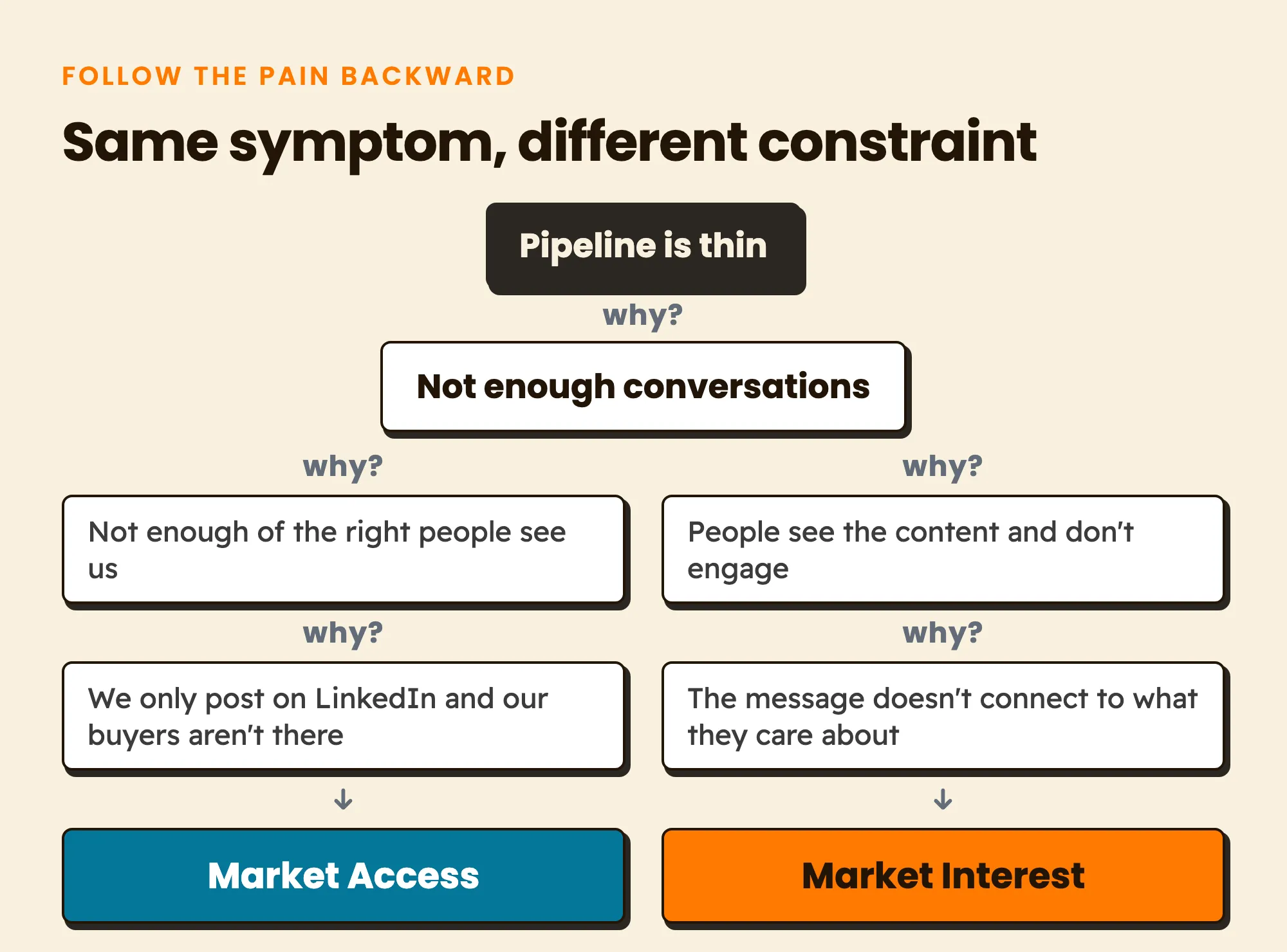
Run the counterfactual. Ask what would happen if you fixed this constraint overnight, and whether growth would follow or you’d hit a different wall immediately. If you got 10x the visibility tomorrow, would those people engage and reach out, or would they land on weak messaging, no proof, and a confusing offer? If the answer is that they’d hit another wall, you’ve either picked the wrong constraint or found a dependency you need to handle first. Either way you learned something for free.
Look for evidence against yourself. Whatever you’ve diagnosed, go hunting for data that contradicts it. Think it’s market access? Check your actual reach, because if thousands of people are seeing your posts and visiting your site without engaging, access isn’t your problem, interest or trust is. Think it’s capacity? Check utilization, because a team that’s 50 percent utilized and still overwhelmed has a coordination or process problem rather than a headcount one. Think it’s conversion? Check pipeline quality, because prospects dropping off for lack of qualification means the problem’s upstream. The goal is making sure you’re not seeing what you’d prefer to see.
Ask the people who’d know. Your diagnosis shouldn’t happen alone in a spreadsheet. If you think it’s delivery, ask your team where things break down, because they’re closer to the work. If you think it’s demand, ask recent prospects why they didn’t buy and recent clients why they did, plus where they almost didn’t. If you think it’s trust, ask someone who fits your ICP to review your public presence and tell you the truth, and not your mom, someone with no reason to be kind. Outside perspectives catch what internal analysis structurally can’t.
Set a validation checkpoint. Don’t commit three months before checking, commit three weeks. Pick one or two early indicators that would confirm the diagnosis, so fixing access means watching reach and new audience growth, fixing conversion means watching response rates and time-to-close on current deals, and fixing capacity means watching utilization or project margin. Work the constraint for three weeks, then look. If the indicators are moving at all, keep going. If nothing’s moving, stop and reassess, because either the diagnosis was wrong, the approach to fixing it is wrong, or three weeks was too short for this particular constraint, and figuring out which one is a twenty-minute conversation rather than another quarter.
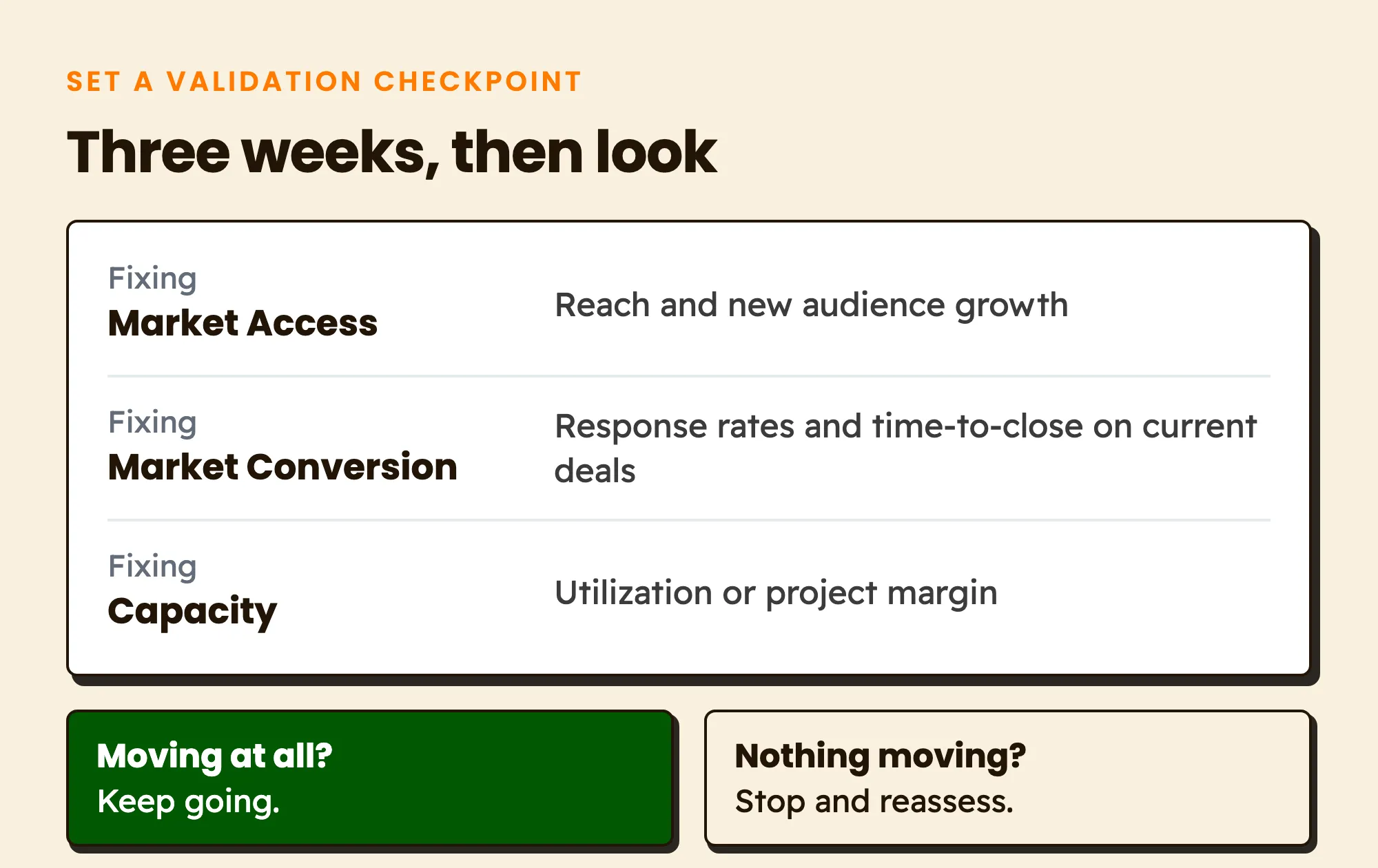
And if you’re wrong? You might be, and it’s survivable. The effort mostly isn’t wasted, since a month spent improving your messaging leaves you with better messaging even if access turned out to be the real limit. The actual cost is opportunity cost, meaning the growth that stayed capped while you optimized something that wasn’t the bottleneck. Even then, focused effort on one wrong constraint beats scattered effort across five right ones, because you learn faster going deep than going wide, and constraints reveal themselves once you start pushing on them. You might start building distribution and realize halfway through that people are seeing you and not caring, which is a better place to be than where you started. Good enough hypothesis, fast feedback, willingness to change your mind.
What to do next
Eight constraints, two buckets. Demand covers Market Access, Market Interest, Market Trust, and Market Conversion. Supply covers Capacity, Capability, Consistency, and Control.
One of them is capping your growth right now. You might have recognized yourself immediately in a section, or two or three might have felt relevant, and that’s normal because most agencies have several live at once. Only one is the bottleneck, though, and that’s the one that gets your quarter.
If you’re not sure which, go back to the top question: do you need more opportunity flowing in, or can you not handle the opportunity you have? Then read those four again and find the one that creates the most acute pain, or more usefully, the one that would free up the most growth if it disappeared. That’s your primary constraint.
Then run the dependency check before you commit, because one at a time doesn’t mean in order. If you’re about to scale visibility on broken trust basics, fix the trust basics first. If you’re about to hire for capacity while your processes live in your head, document the processes first. The point is making sure that removing your primary constraint doesn’t expose something worse underneath it.
After that, focus everything there and let the rest wait. It might take weeks or months, and the clarity of pointing at one thing will produce more movement than spreading yourself across five ever has. Then the next constraint shows up, and you do it again. That’s the actual mechanic behind agencies that grow consistently: they’re the ones who correctly name what matters most right now and hammer it until it breaks, while everyone else is doing all eight at once.
So find yours, and go remove it.
If you want help figuring out which constraint is holding you back, or you want to work through the fixes for your specific situation, join the Dynamic Agency Community. We run constraint mapping with agency owners every week.

FAQ
What is the Agency Constraint Map?
It’s a diagnostic that sorts agency growth problems into eight named constraints under two headings. Demand covers Market Access, Market Interest, Market Trust, and Market Conversion. Supply covers Capacity, Capability, Consistency, and Control. The sorting is the useful part, because the thing you feel is a symptom and the eight are where the symptom originates, so naming which one you’re in stops you buying a fix a level too high.
How do I know if I have a demand problem or a supply problem?
Imagine three qualified leads landed in your inbox tomorrow. If that would fix your biggest problem, you’re demand-constrained. If it would wreck your week, you’re supply-constrained. Almost everyone answers that in about four seconds, and the answer decides which half of the map you read.
What if more than one constraint applies to me?
Several usually do, which is normal and not a sign you’ve read it wrong. Only one of them is setting your ceiling, though, and the way to find it is asking which one, removed tomorrow, would free up the most growth. The others stay annoying and stay parked.
What happens if I pick the wrong constraint?
Less than you’d think. A month spent sharpening your messaging leaves you with sharper messaging even when access turns out to be the real limit, so the loss is the growth that stayed capped rather than the work itself. Focus on one wrong thing still outperforms effort split fifteen ways, and constraints tend to announce themselves once you start pushing on them.
Do I always work on the primary constraint first?
No, and this is where the map gets misused. Check dependencies before you commit, because scaling visibility on top of missing proof buys you a bigger audience for a weak hand, and hiring into a business whose processes live in your head buys you a more expensive version of the same bottleneck. Sometimes the smaller constraint has to go first because the big one depends on it.
How long does it take to remove a constraint?
It varies by constraint and the honest ranges are wide. Conversion friction and pricing clarity can shift inside a few weeks, since most of that work is decisions you control. Capacity runs at the speed of hiring plus ramp, so budget a quarter. Trust is the slow one, because proof, outside validation, and a visible track record accumulate over months and can’t be sprinted. Which is exactly why trust-constrained agencies keep finding reasons to go work on access instead.
Where to go next
If the constraint turns out to be capacity, should I hire when my agency is overloaded works through whether hiring is the answer.
A related question with a different answer: should you stop marketing when delivery is overloaded.
If it shows up as a tradeoff between winning work and keeping clients happy, how I stopped choosing between new clients and happy clients is the version I got wrong for years.
And if the limit is your own hours, the 10-80-10 rule is how to hand work off without losing the quality.
If you can’t tell whether you’re overloaded or just stuck, what Delivery Drag is names the loop where client work crowds out every growth move, and why waiting to get ahead of the work never ends it.
If the financial fragility section hit home and your instinct is to fix margins before anything else, revenue earns you the right to optimize profit makes the case that margin work on a small base is usually the wrong fight. And if you’re tempted to answer a capability or control problem with more tools, how I learned to stop worrying and love AI automation is about getting the efficiency without turning client relationships cold.
If consistency is the constraint and you’ve started to feel it in renewals, why clients replace agencies that are doing great work covers the accounts that get cut at budget review because nobody on the client side can see the work anymore.
And if you’re comparing this map to the other models on your shelf, which agency growth frameworks hold up gives you four questions that separate a working framework from renamed best practices, run against my own models too.